
Weigh-In Dynamics and Friday Morning Odds Shifts
I once watched a fighter visibly stumble onto the scale at 11am on Friday, miss weight by 1.2 pounds, accept the standard fine and percentage forfeit to her opponent, and step into the cage Saturday night looking smaller than she had in any pre-fight image from the camp. Her opponent – who’d made weight comfortably – controlled the fight from the opening bell and finished in the second round. The Moneyline closing price on the eventual winner had drifted from -150 American odds on Tuesday to -240 by Saturday afternoon. The market knew. I’d skipped the bet because I hadn’t yet learned to read weigh-ins as a betting signal. A brutal weight cut can drain a fighter’s cardio, a factor that becomes even more critical when analyzing short-notice replacement fights.
The signal I was missing is the most underused information in UFC handicapping. Weight cuts and the rehydration window between Friday’s weigh-in and Saturday’s fight are arguably the largest single variable affecting fight outcomes that isn’t fully priced into pre-fight Moneylines. This piece is about how to read the weigh-in for betting purposes – what to watch for, what the numbers say, and how UK operator models treat the signal.
The biology nobody mentions on the broadcast
UFC athletes lose roughly 6.7% of their body mass in the 72 hours before weigh-in, and regain roughly 9.7% in the 24-36 hours after. The numbers come from peer-reviewed work on combat sport weight-cutting practice and are remarkably consistent across weight classes. A lightweight cutting to 155 pounds is losing approximately 10-11 pounds in the final three days; a heavyweight cutting to a contracted weight is losing proportionally less in absolute terms but the percentages are similar.
The 9.7% rehydration regain is what creates the asymmetry. A fighter who made 155 pounds on Friday morning might step into the cage Saturday at 170+ pounds. A fighter who made 155 pounds with a longer or rougher cut might step into the cage at 165 or 168 because the rehydration was incomplete. The “weight class” the fight nominally takes place at is a Friday-morning fiction; the actual weight differential on Saturday night can be anything from a few pounds to ten or more.
This biological reality means the weight cut process is not a neutral preparatory ritual. It’s a physiologically taxing event whose execution quality affects everything: cardio, focus, strike output, takedown defence, chin durability, recovery between rounds. Reading the cut quality is reading a major Saturday-night variable.
What to actually watch at the weigh-in
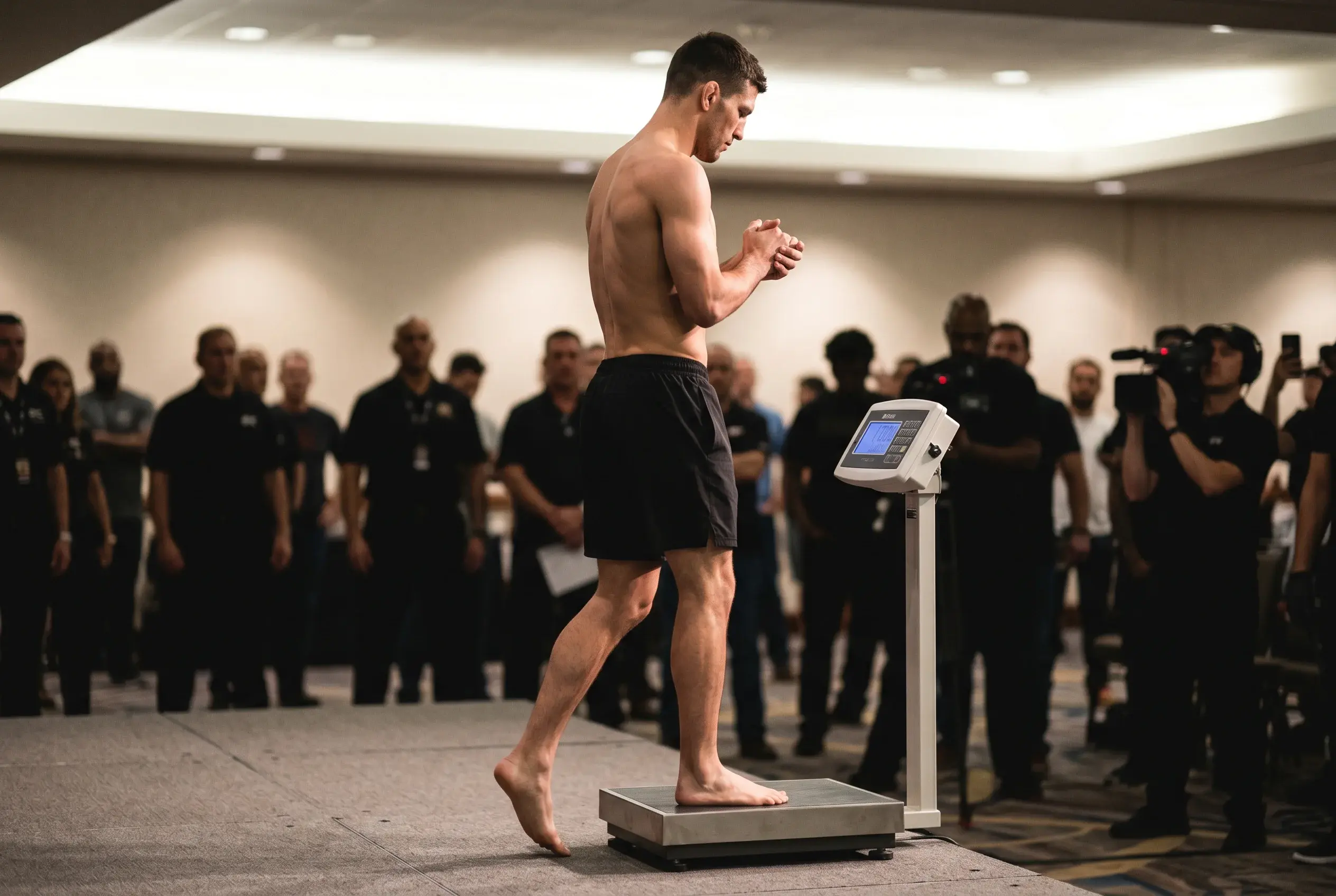
Body composition is the first read. A fighter who steps on the scale looking visibly drawn – collapsed cheeks, sunken eyes, prominent ribs and clavicles – is mid-rehydration-debt and may be carrying that debt into the fight even after the 24-36 hour rehydration window. The visual signal is rough but consistent: fighters who look comfortable at the scale generally are; fighters who look distressed are signalling something the broadcast won’t address.
Stability on the scale is the second read. Fighters who step on, stand still, and step off without visible balance issues are in good condition. Fighters who sway, lean against the wall, or require assistance off the scale are showing signs of a cut that’s affected their motor function. The motor signal correlates with cardio compromise and reaction speed in the cage.
The on-stage interaction is the third read. The face-off after weigh-in is a low-stakes interaction but reveals a lot. Fighters whose stare is unfocused or whose posture is slumped at face-off are giving more information than they realise. Fighters who maintain clear eye contact and stable posture are signalling normal recovery readiness.
The fourth read is the percentage miss for fighters who don’t make weight. A 0.5-pound miss is annoying for the fighter, financially material for them, but doesn’t usually indicate a catastrophic cut. A 2.0-pound miss generally indicates either a deliberate decision to take the percentage forfeit (which sometimes happens with fighters who realise the cut isn’t going to make weight and stop torturing themselves) or a cut that went very wrong. Either way, the fight that follows is happening at a different weight differential than the contract implies.
The fighters whose cuts are systemically suspect
Some UFC fighters have weight-cut histories that should colour any pre-fight read. The signals to look for are: history of missed weight, history of needing IV rehydration support (which is now banned in USADA testing but the historical pattern remains relevant), history of competing in multiple weight classes (suggesting their natural walking weight doesn’t fit any specific class neatly), and history of poor performances when fighting on short rest after particularly difficult cuts.
Fighters who’ve moved up a weight class are typically less concerning in cut terms than fighters who’ve moved down or who are at the upper limit of their current class. The reverse signal – moving up – usually indicates the previous class was a strain, and the new class allows a cleaner cut. The fighter who’s spent four years at lightweight and moves to welterweight is usually a different (better-conditioned) version of themselves at the new weight.
Fighters at the upper threshold of a weight class are different. A fighter who walks at 175 pounds and cuts to 155 is doing a 20-pound cut in the final week, with most of that loss in the final three days. The same fighter at 175 walking weight cutting to 170 is doing a manageable 5-pound trim. The signal isn’t always available – fighter walking weights aren’t published systematically – but interviews and camp footage often reveal it for those willing to track.
How the cut affects round-by-round performance
A rough cut compromises the third round before any other round. The first two rounds are typically fueled by adrenaline, glycogen reserves, and the fighter’s normal training-adapted capacity. The third round is where cardiovascular debt from the cut surfaces – heart rate doesn’t recover between rounds at the normal rate, recovery breathing in the corner is shorter and less effective, and strike output drops measurably.
This pattern matters for round-specific and total-rounds betting. A fighter coming off a rough cut against an opponent with a normal cut is meaningfully more likely to lose round three than rounds one or two. Over 2.5 rounds bets favour the cut-disadvantaged fighter making the fight longer; under 2.5 rounds bets favour earlier finishes when the cardio-compromised fighter is being pressured.
For five-round fights, the effect compounds. Fighters with rough cuts who make it to round four are typically running on fumes, with cardio so depleted that even modest exchanges produce defensive lapses. The late-round comeback narrative – fighter gets second wind, finishes opponent – applies almost exclusively to fighters whose cut was clean and whose conditioning was preserved. Rough-cut fighters don’t have a second wind because the systemic depletion is too deep.
The market lag on weigh-in information
UK operator pricing models do incorporate weigh-in information, but with a notable lag. The Friday morning weigh-in produces visible signal, but operator models typically don’t fully integrate it into Saturday pricing for several hours after the official weights are announced. The market often spends Friday afternoon settling at adjusted prices, with the biggest moves happening between 4pm and 8pm UK time as sharp money reacts to the visual evidence the morning weigh-in produced.
The window for trading on weigh-in information is real but narrow. Sharp bettors who watch the weigh-in stream and react to visual evidence within the first hour or two often get the best of the move. Recreational bettors who check prices on Saturday morning are typically betting into prices that have already absorbed the weigh-in signal.
What hasn’t been fully priced in even by Saturday morning is qualitative cut information that wasn’t visible at the official weigh-in. Camp footage, training partner reports, social media disclosures from fighters about their cut difficulty – all of this is harder for operator models to ingest and process. Bettors who track this information across multiple sources sometimes find pricing that hasn’t absorbed it.
The missed-weight scenarios and bet grading
When a fighter misses weight, the fight typically still happens at a catch weight (the higher of the two weights, with the missing fighter losing a percentage of their purse to the opponent who made weight). UK operators typically grade bets normally in this scenario – the fight happens, results count, Moneyline and method bets are settled as standard.
The complication is when a missed weight is severe enough that the fight is cancelled – usually when the percentage miss is so large that either fighter declines to compete, or when the missed weight indicates a medical issue (e.g. a fighter passes out at the scale and is hospitalised). In these cases, operator rules apply. Most UK books void all bets and refund stakes when a UFC fight is cancelled pre-event for missed weight reasons. Some operators have specific terms for what constitutes a cancellation; checking the rules at your operator for the specific scenario is worthwhile.
If a fight is rescheduled at a later date with the same fighters, most operators continue to honour the bet at the original odds for the rescheduled date – but the timeline matters, and some operators void bets if the rescheduled fight is more than a certain period (often 30 days) after the original. The specific terms are operator-specific.
Why this signal will outlive the system improvements
Operator models improve over time. The metrics that were systematically underpriced in 2020 – wrestling-specific defensive numbers, late-round differentials – are more efficiently priced in 2026. Weight cut information is harder to model because the visual and qualitative signals don’t reduce cleanly to input variables. The fighter who looks drawn versus the fighter who looks fresh is a judgment call that resists tidy quantification, and operator models that try to ingest it via proxy metrics (weight class history, missed-weight history) capture only a fraction of the information.
This means weigh-in reading is likely to remain a real edge longer than most quantitative betting edges. The signal is available to anyone willing to watch the Friday morning stream and process visual cues, but it requires a kind of attention that systematic betting models struggle to replicate. Bettors who develop the reading skill have access to information that’s genuinely under-incorporated into UK pricing models.
The work isn’t glamorous. Friday morning weigh-ins are tedious viewing, and most of the signals are subtle. But across a year of UFC cards, the bettors who track this signal consistently produce some of the cleanest edge-positive long-run records I’ve seen. The bettors who skip the Friday morning routine are leaving genuine value on the table. The same kind of attentional discipline applies when reading what fighters bring into the cage stylistically – stance matchups in UFC betting reward similar close-watch habits. Get the most accurate fight week predictions from the number one UK UFC betting resource.