
Converting Sportsbook Prices into Implied Probabilities
There’s a question you should ask every time you look at a UFC price: does the book think my fighter wins more or less often than I do? You can’t answer it while staring at “4/9” or “1.44” or “−225”. Those are payout instructions. They tell you what you win for what you stake, but they don’t tell you whether the bet is good value. To answer the value question you have to convert the price into an implied probability – what the sportsbook thinks the chance of that outcome actually is.
Once you can convert quickly between formats, the entire UFC market becomes more legible. A favourite at 1/2 is the book saying “this happens about 67% of the time after our margin”. An underdog at 9/2 is the book saying “this happens about 18%”. Your job as a punter is to decide whether those numbers feel right based on what you know about the fighters, the matchup and the division. If you think the favourite wins more like 75% of the time, the 1/2 price is value. If you think the underdog wins 25%, the 9/2 is value. The conversion is what makes that comparison possible.
This piece walks through the maths for each of the three odds formats UK punters encounter, why two-sided UFC prices always add up to more than 100%, and how to strip out the bookmaker’s margin to recover the cleaner probability estimate underneath. Once you can do this in your head – and you can, with practice – UFC betting starts looking like an information game rather than a guessing game.
What implied probability is and why it isn’t quite the same as the bookmaker’s real opinion
Implied probability is the percentage chance an outcome would need to have, given the price offered, for the bet to be a perfectly fair zero-margin wager over the long run. If the price is 1/1 (decimal 2.0), the implied probability is 50%. If the price is 1/4 (decimal 1.25), the implied probability is 80%. The maths is simple division, which I’ll work through in the next sections.
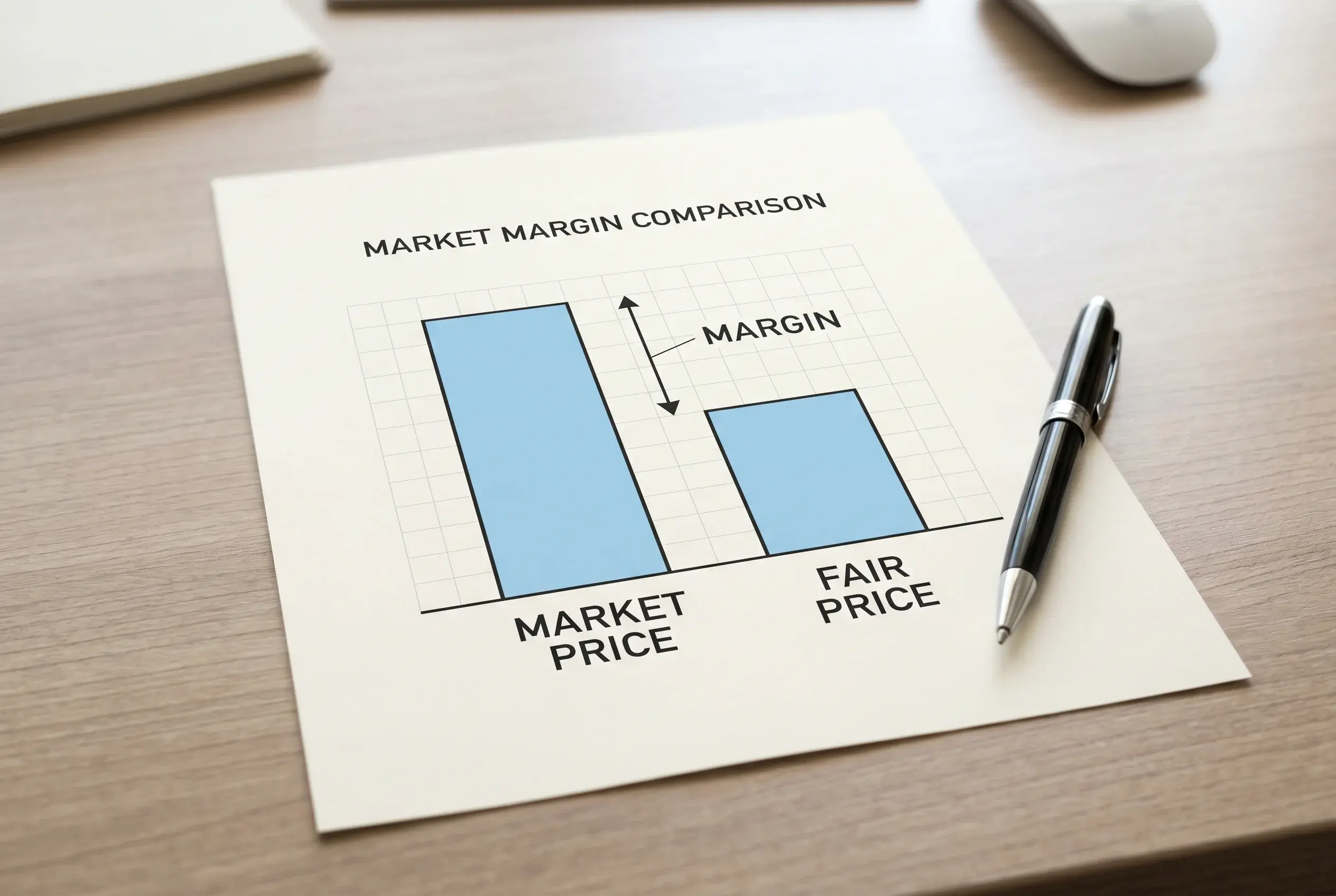
The crucial distinction: implied probability is not the same as the bookmaker’s actual probability estimate. The book builds a margin into every price – the overround – that means the prices on both sides of a UFC fight always sum to more than 100% in implied probability terms. The real probability estimate sits inside the margin somewhere, not at the surface.
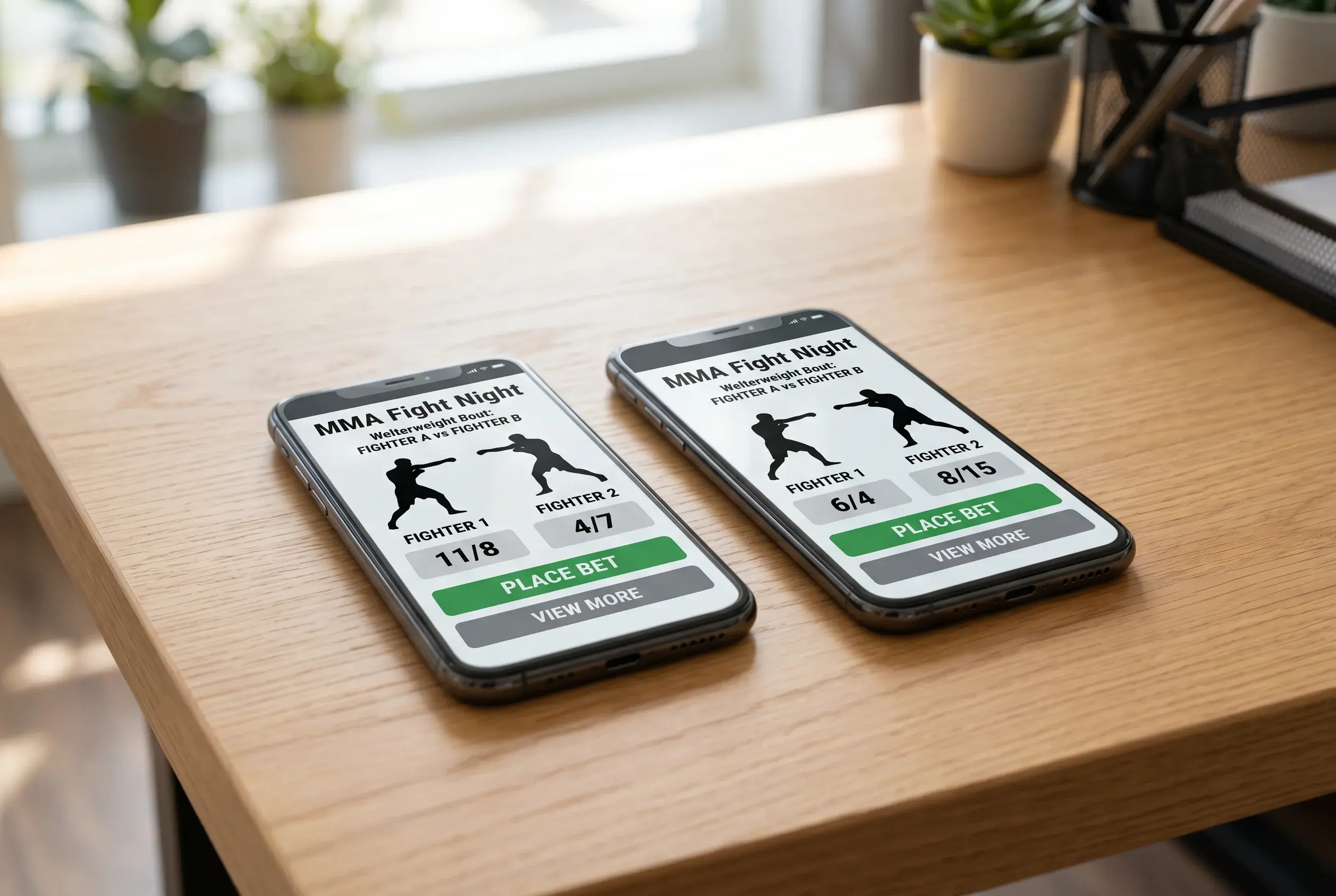
An example. A UFC Moneyline market with Fighter A at 1/2 and Fighter B at 13/8. Fighter A’s implied probability is 66.7%. Fighter B’s implied probability is 38.1%. Together that’s 104.8%, so the book is running about 4.8% overround. The true probability the book thinks Fighter A wins is somewhere around 64% – the 66.7% number includes a slice of margin. Same logic applies to Fighter B: the true estimate is around 36%, the displayed implied probability is inflated to 38.1% by the overround.
For most practical betting decisions, working with the implied probability directly is fine – you’re comparing it to your own estimate, and the margin pushes both sides upward equally, so the comparison is still meaningful. But knowing that the surface number isn’t the book’s real opinion matters when you start comparing books or building models.
Converting fractional odds to implied probability
The fractional formula: implied probability = denominator / (numerator + denominator). Then multiply by 100 to get a percentage.
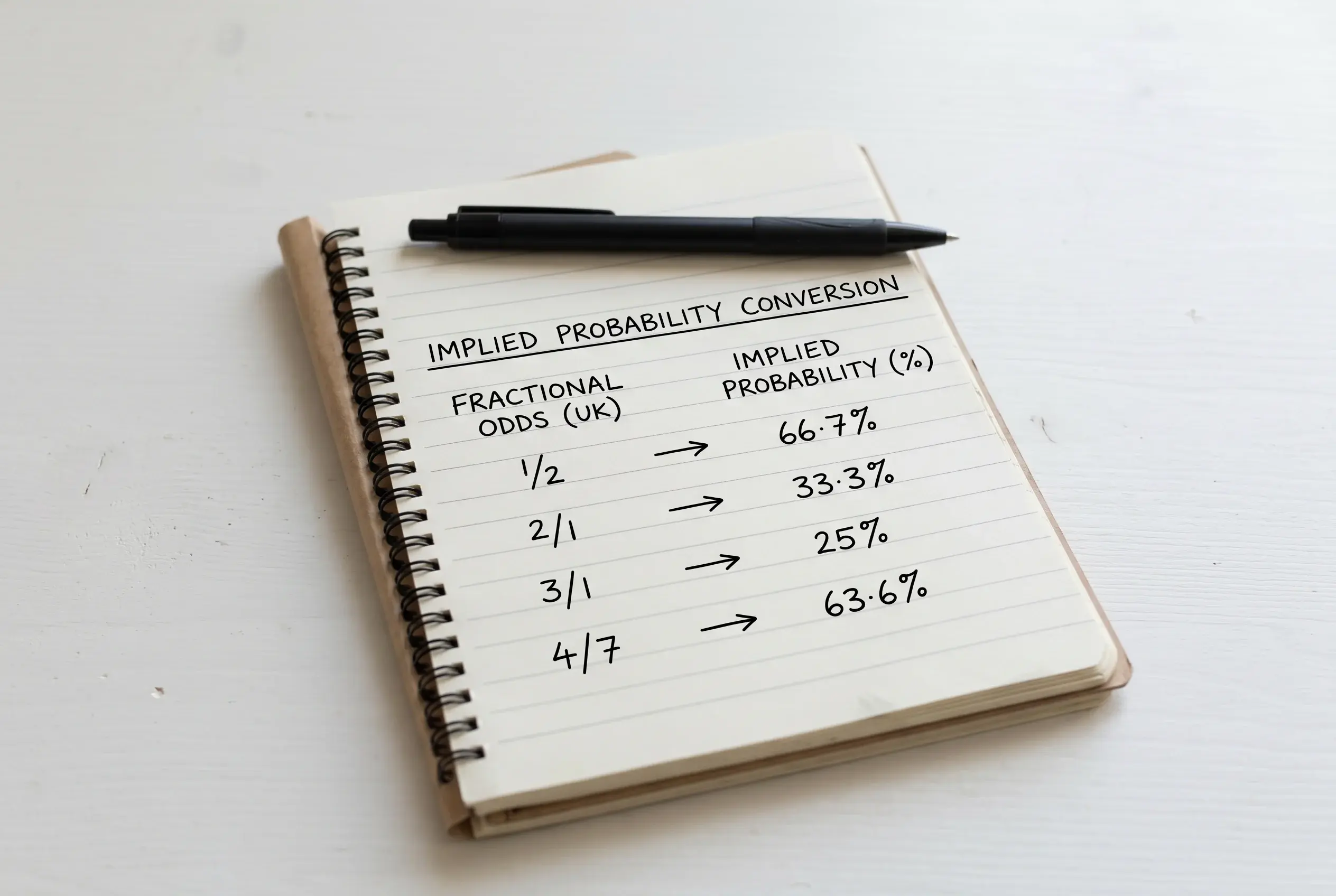
For 1/2: denominator is 2, numerator + denominator is 3, so 2/3 = 66.67%. For 4/9: denominator is 9, numerator + denominator is 13, so 9/13 = 69.23%. For 2/1: denominator is 1, numerator + denominator is 3, so 1/3 = 33.33%. For 7/4: denominator is 4, numerator + denominator is 11, so 4/11 = 36.36%.
The pattern is easier than the formula. When the fraction is below 1/1 (favourites: 1/2, 4/9, 5/6), the implied probability is above 50%. When the fraction is above 1/1 (underdogs: 6/4, 2/1, 5/1), the implied probability is below 50%. The “evens” point – 1/1 – is the 50% line, where the fighter is treated as a coin flip.
The shortcut I use most: the implied probability of a fractional price equals the denominator divided by the sum of numerator and denominator. For mental maths, the trick is to combine the two numbers. 4/9 becomes 9 out of 13. 7/4 becomes 4 out of 11. Once you’ve done a few hundred of these the conversion happens in real time. The hard ones to mental-maths are mid-range underdog prices like 11/8 (8/19 = 42.1%) and 9/4 (4/13 = 30.8%). Worth memorising a handful of common ones.
Converting decimal odds to implied probability
The decimal formula is simpler: implied probability = 1 / decimal odds. Then multiply by 100.
For decimal 2.0: 1/2.0 = 50%. For decimal 1.50: 1/1.50 = 66.67%. For decimal 3.50: 1/3.50 = 28.57%. For decimal 1.25: 1/1.25 = 80%. For decimal 4.50: 1/4.50 = 22.22%.
Decimal is the format I’d recommend any UFC punter switch their account preference to, if they haven’t already. The conversion to implied probability is one operation – divide one by the price. Compared to the fractional formula’s two-step process, it’s faster. And decimal also handles parlay maths more cleanly (multiply the decimal prices together to get the combined parlay price).
The intuitive read: decimal 2.0 is 50%, decimal 4.0 is 25%, decimal 10.0 is 10%. The relationship is reciprocal – double the price, halve the implied probability. For prices between these benchmarks the conversion is a quick mental approximation. Decimal 3.0 sits between 50% and 25%, closer to 33%. Decimal 5.0 sits between 25% and 10%, closer to 20%.
Converting American odds to implied probability
American odds are the format UK punters encounter most often in US-facing UFC coverage – ESPN articles, DraftKings content, podcast discussions. UK sportsbooks don’t usually display American format by default, but it appears enough in adjacent content that knowing the conversion saves confusion. UFC content from US sources almost universally uses American format.
The American format has two variants. Negative numbers (favourites): the price is what you have to stake to win $100. −180 means stake $180 to win $100. Positive numbers (underdogs): the price is what you win on a $100 stake. +220 means stake $100 to win $220.
Conversion to implied probability has two formulas, one for each sign. For negative odds: implied probability = |odds| / (|odds| + 100). For −180: 180 / (180 + 100) = 180/280 = 64.29%. For −300: 300/400 = 75%. For positive odds: implied probability = 100 / (odds + 100). For +220: 100/320 = 31.25%. For +400: 100/500 = 20%.
The mental shortcut for negative odds: divide the absolute value by itself plus 100. The shortcut for positive odds: take 100 divided by the price plus 100. With practice these become quick, but if you’re moving between formats often it’s worth keeping a conversion table accessible – there’s no virtue in doing the mental maths if the price hasn’t changed by the time you’ve worked it out.
The biggest underdog winner in UFC history closed at +950 American – that’s 100/1050 = 9.5% implied probability. Shana Dobson against Mariya Agapova in 2020, KO win on the night. The −1400 line on her opponent meant 1400/1500 = 93.3% implied probability. The actual outcome obviously didn’t match the book’s estimate, which is why long-shot prices exist – sometimes the long shot is right and the book is paying for it.
Why two-sided UFC prices always exceed 100% probability
Take any UFC fight, look at both Moneyline prices, convert each to implied probability and add them together. The total will be somewhere between 102% and 110% on most UK operators. This isn’t a maths error – it’s the bookmaker’s margin showing up in the numbers.
The margin is the overround, sometimes called juice or vig. It’s the cost of the bet, built into the prices on both sides. If a fight were priced perfectly fairly with zero margin, the two implied probabilities would sum to exactly 100%. Books never offer that because they need to make money on the spread between the prices and the actual outcomes over thousands of bets.
Typical UFC main-event overrounds at major UK operators sit between 4% and 6% – meaning the two implied probabilities sum to between 104% and 106%. Smaller markets like prop bets and round betting carry larger overrounds, often 10-15%. The total can climb to 120% or higher on niche markets where the trader has less confidence in the underlying probability.
Practically, when you’re evaluating a bet, you can either accept that you’re comparing your estimate against an inflated number (your fighter at 67% vs the book’s 64-65%), or you can strip out the margin first to recover a cleaner book estimate. The next section walks through how to do that.
Stripping overround to recover a fair probability
To strip the overround out of a two-sided UFC market, divide each implied probability by the total. If Fighter A is 66.7% and Fighter B is 38.1%, total is 104.8%. Fighter A’s overround-adjusted probability: 66.7 / 104.8 = 63.6%. Fighter B’s overround-adjusted probability: 38.1 / 104.8 = 36.4%. Together they now sum to exactly 100%, which is what a fair market would look like.
This is what I’d call the book’s stripped estimate – a close approximation of what the trader actually thinks each fighter’s chance of winning is. Comparing your own probability estimate against the stripped number is more meaningful than comparing against the surface implied probability, because you’re stripping out the margin that both sides share equally.
For three-way UFC markets – including Draw – the same logic applies, just with three implied probabilities to add and divide by the total. If Fighter A is 64%, Fighter B is 35%, and Draw is 3%, total is 102%. Stripped: A = 62.7%, B = 34.3%, Draw = 2.9%. The margin is smaller on three-way markets, typically 2-4%, because there are more selections to absorb it.
The limitation of this approach: it assumes the overround is distributed evenly across the prices, which isn’t always true. Some books shade the margin more heavily onto the favourite (so the underdog price stays attractive) or more heavily onto the underdog (so the favourite price stays attractive). The stripped numbers are a good approximation, not a precise reverse-engineering of the trader’s model. The natural follow-on once you understand how to strip margin from prices is to look at UFC overround and bookmaker margin in more depth – how UK books actually build the margin, what typical margins look like across markets, and why some markets carry much higher juice than others.