

Evaluating Top UK Sportsbooks for UFC Wagering
Nine years into covering UFC markets for a living, I still get the same email every fight week: "Mate, where do I even start with this stuff?" It usually comes from a football punter who has watched one Aspinall finish on a phone screen, decided the heavyweight division looks like easy money, and discovered that UFC odds in the UK do not behave like a Premier League match price at all. So let me start by drawing a hard line. Betting on UFC in the UK is not the same animal as sports betting in general. It sits inside a tightly regulated slice of the real event betting market — the same market that produced £596 million in gross gambling yield in the fourth quarter of the 2024/25 financial year — and competes for your attention with an enormous offshore shadow market that is not regulated at all.
That distinction matters more than any single tip I could hand you. A UFC fight is one event, not a league with thirty fixtures a week. Five legitimate outcomes in a three-round bout, every market downstream of the moneyline is a derivative of it, and the operator holding your stake is either licensed by the UK Gambling Commission or it is not. No in-between.
This guide is my attempt to give a UK reader the complete picture in 2026: how the markets work, how the odds are priced, what changed legally last year, how to read a fight card before I commit a pound, and where the genuine risks live. I am not here to rank operators or pitch you a free bet. I am here to make you a sharper, calmer, better-informed bettor by the end of the page.
What This Guide Gives You in 90 Seconds
- UFC betting in the UK runs inside a regulated real event market that produced £596 million in online GGY in Q4 2024/25 — only UKGC-licensed operators carry the 2025 protections.
- Across UFC history favourites win about 68% of fights, with 2024 running at 72%; men's flyweight favourites since 2020 sit at a 77% strike rate.
- The 2025 reforms — statutory levy, financial vulnerability checks, deposit-limit prompts and per-product marketing consent — changed what your sportsbook can and must do.
- The offshore market turned over £16.6 billion in 2025 with no obligations to UK customers; verify a UKGC licence number before depositing anywhere.
- The 2026 calendar runs 13 numbered events and 30 Fight Nights on TNT Sports in the UK, with a 20-to-40-second broadcast lag versus operator data feeds.
Inside This Guide
- Why UFC Betting in the UK Is Its Own Thing
- The UK UFC Betting Landscape Right Now
- How UFC Quietly Became a UK Betting Staple
- The 2026 Legal Framework Every UK Bettor Should Understand
- The Core UFC Betting Markets at a Glance
- How UFC Odds Actually Work for UK Punters
- Choosing a UKGC-Licensed Sportsbook for UFC
- Reading a Fight Like an Analyst, Not a Fan
- Live and In-Play Betting on UFC Fights
- Bankroll Management and Keeping UFC Betting Sustainable
- Why the Black Market Is Not a Shortcut
- The 2026 UFC Calendar and UK Broadcast Reality
- Frequently Asked Questions About UK UFC Betting
- Where This Leaves a Thoughtful UK UFC Bettor
The UK UFC Betting Landscape Right Now
Here is something most punters do not realise until they look it up. The UK is the third largest source of traffic to ufc.com on the planet, behind only the United States and Canada, with 6.84% of all visits coming from British IP addresses. Stop and think about that. We do not have a single American-born promotion headquartered here, no domestic heavyweight champion until very recently, and our prime-time slot puts the main event after most people's bedtime. Yet we still out-click Brazil, Australia and every European market combined.
That hunger feeds straight into the betting economy. The online segment of UK gambling produced £1.45 billion in gross gambling yield in Q1 2025 — a seven percent jump year on year — and the slice attributable to real event betting (the regulator's umbrella term covering UFC alongside football, racing and the rest) came in at £596 million for the same period. UFC does not have its own line in the Commission's reporting, but anyone who has worked in trading rooms here will tell you fight nights now reliably move the needle on Saturday evenings.

£1.45bn
UK online gross gambling yield, Q1 2025, up 7% year on year.
£596m
Online real event betting GGY in the same quarter — the bucket UFC lives in.
13.5m
Average monthly active online gambling accounts across the UK in Q1 2025.
6.84%
Share of global ufc.com traffic coming from the United Kingdom — third in the world.
Twelve percent of British adults reported some form of betting activity in the four weeks before being surveyed in the second wave of the Gambling Survey of Great Britain in 2025 — the second most popular gambling activity after lottery draws. Sixteen percent of men over eighteen had placed a bet in that window. The audience for fight night is not a niche subculture. It is a mainstream slice of the country, phone in hand.
One small data point worth filing away: by April 2025 the UK still housed 5,825 high-street betting shops, down only 1.8% year on year. Walk into one on a Saturday and you can place a UFC moneyline at the counter. The image of MMA betting as a purely digital, young-male hobby is out of date.
The competitive picture matters too. UK-licensed operators are not the only people targeting British UFC fans. Alongside the regulated industry sits a parallel market — offshore sites, unlicensed sportsbooks, slick-looking apps with no UKGC seal — that turned over an estimated £16.6 billion in 2025, up from roughly £5 billion in 2019. More on that later. For now, hold the contrast in your head: a growing, properly regulated UK fight-betting market on one side, a much larger shadow economy on the other.
Live Tracker
How UFC Quietly Became a UK Betting Staple
I was sitting in a Manchester pub in 2018 when a barman recognised the UFC walkout music on the telly and asked who I had backed. That moment told me something the data took another five years to confirm. UFC had stopped being a niche American import and started becoming weekend appointment viewing that bookmakers build markets around. The growth was not loud — no Super Bowl moment, no single weekend you could point to and say "this is when it changed" — but it was steady and deep.
The combat sports market surrounding it has grown in lockstep. Global MMA was valued at $1.5 billion in 2024 with credible forecasts pointing to $3.5 billion by 2030 at a compound annual rate of around 12 percent. Worldwide MMA event count more than doubled from 100 to 110 in 2020 to a projected 180 to 200 in 2025. More fights, more cards, more weeks where a UK punter can find a fight to wager on.
The pandemic accelerated everything. While football paused, UFC kept fighting on Fight Island and elsewhere, importing a new audience that has never left. Dana White put it bluntly: the promotion gained a lot of fans because there was nothing else to gamble on, sports bettors started betting on UFC, and once they started watching they fell in love with it. Exactly what the volume curves show.
"This deal puts UFC amongst the biggest sports in the world."
Dana White, President, UFC, on the Paramount broadcast deal announced in 2025
Then 2026 happened. The Paramount era of UFC kicked off this year on the back of a deal paying the promotion an average of $1.1 billion per year over seven years, with 13 numbered events and 30 Fight Night cards on the calendar. Crucially for us, TNT Sports remains the UK broadcaster — the picture has not fragmented for British viewers the way it has for American ones. Same channel, same pundits, same broadcast feed.
There is one more factor I keep coming back to: the UK now has a heavyweight champion. Tom Aspinall is a Manchester-born finisher whose record-setting pace turned him into a household name in a country that had never produced a UFC heavyweight title-holder before. When the local title-holder fights, the casual punter who would normally only bet on football suddenly opens their app. Aspinall represents a structural shift — reasons to care about the result. That is what turns occasional bettors into regulars.
The 2026 Legal Framework Every UK Bettor Should Understand
If you opened a UFC betting account in 2023 and have not touched the rules since, you are operating on a map that no longer matches the territory. 2025 was the year UK gambling regulation moved from the long-promised White Paper to enforced statute, and 2026 is the first full calendar year where every operator must comply with the new framework from day one. The shifts are not cosmetic — they change what an operator can offer, what they must check before taking your stake, and how you experience the product.
Four changes matter most for somebody betting on UFC.

The 21 May 2025 stake limits introduced a £2 per spin cap on online slots for adults aged 18 to 24, with £5 for everyone older. The headline applies to slots rather than sportsbook stakes, but the operator-level infrastructure it forced — age banding, real-time stake monitoring, granular controls — is the same plumbing now governing your UFC account. Six weeks earlier, on 6 April 2025, the Gambling Levy Regulations replaced voluntary contributions with a statutory levy of between 0.1% and 1.1% of gross gambling yield. That money funds research, prevention and treatment of gambling harm — and applies cost pressure to every UK book taking your fight bet.
Financial vulnerability checks went live on 28 February 2025. Light-touch reviews happen at internal trigger points, with deeper assessments when activity escalates. From 1 May 2025, operators can send direct marketing only if you have consented per product — casino, bingo, betting separately — and per channel (SMS, email, etc.). From 31 October 2025, Remote Technical Standards changes require operators to prompt new customers to set a financial limit during sign-up.
"The 2025 reforms represent a decisive shift in UK gambling regulation, and with the introduction of a statutory levy, targeted stake limits, and enhanced consumer protections, the UK is positioning itself as a global leader in responsible gambling regulation."
Clifford Chance Legal Analysis
What does all this mean for you, the UFC bettor, at four in the morning after the main event has just been settled? Your account is being read more carefully than two years ago. Your marketing inbox should be quieter unless you have actively opted in. And the operator's cost base is fractionally higher, which over time shows up in tighter promotions and larger margins on niche markets.
Before your next UFC bet, run this five-point legal sense-check
- Confirm the operator is listed on the public UK Gambling Commission register and the licence number on its footer matches the register.
- Check that the domain in your browser bar actually belongs to that licensed entity, not a similar-sounding lookalike.
- Set a deposit limit you can stick to before you place a single stake.
- Review your marketing preferences and uncheck any product or channel you did not deliberately opt into.
- If anything feels off about a financial check request, pause and read the operator's published guidance before uploading documents.
The full operator-side mechanics of these reforms — what each rule means in practice for your sportsbook account — sit in the picking-a-sportsbook section that follows. The headline is that "licensed in the UK" carries more weight in 2026 than it did in 2024. A feature, not a bug.
The Core UFC Betting Markets at a Glance
Ask ten new UFC bettors what they are betting on and nine will say "who wins". Not wrong — the moneyline is the foundation of everything — but if it is the only market you ever use, you are leaving most of the value, and most of the fun, on the table. Every market a UK sportsbook lists for a UFC fight is a derivative of the moneyline. Once you understand how those derivatives fan out, the screen of prices stops looking like noise and starts looking like a menu.
Short version of each, with the framing I would use over a pint.
Moneyline — a single bet on who wins, regardless of how. Also called Match Winner or Fight Winner. The price the entire card revolves around. Across UFC history, favourites cash this at roughly 68%, underdogs at 32%.
Method of Victory — you pick the winner and how they win: KO/TKO, submission, or decision. The price gets longer than the moneyline because you are narrowing the outcome to one of six legitimate paths.
Round Betting — you back a specific fighter to win in a named round. Round 1 prices are usually the heftiest because finishing within five minutes is hard even for the heaviest hitters.
Total Rounds Over/Under — the bookmaker sets a half-round line (2.5 in three-rounders, 4.5 in championship five-rounders) and you take Over or Under. A common entry point for football bettors who already understand goal totals.
Fight to Go the Distance — a two-way market: yes or no on whether the fight reaches the final bell. Essentially Total Rounds set at the highest threshold, but priced as a binary.
Prop bets and specials — from "fight ends by submission" anywhere on the card to "Performance of the Night to a named fighter". Wider margins, narrower value windows, highest entertainment factor.
Outright and Futures — bets settled weeks or months later, like "next heavyweight champion". Long-term holds rather than fight-night bets, with thinner liquidity.
The thing nobody tells you when you first see these markets stacked is that they are not independent. The moneyline drives Method of Victory, which drives Round Betting, which feeds the Fight to Go the Distance line. Spot one number that looks wrong, check the others before you stake — either the operator has mispriced, or you have.
| Market type | Typical price range | Beginner friendly? | Best used when |
|---|---|---|---|
| Moneyline | Short on favourites, long on underdogs | Yes, the natural starting point | You have a clear view on who wins, no view on how |
| Method of Victory | Medium to long, narrower outcome | Once moneyline feels comfortable | Stylistic mismatch points to a specific finish |
| Round Betting | Long across the board | Intermediate, easy to lose value | You have a strong read on pace and finishing windows |
| Total Rounds Over/Under | Around evens with a margin | Yes, mirrors football totals | You disagree with the operator on fight length |
| Prop bets and specials | Wide, often very long | Better as entertainment than core staking | Small fun-money allocation only |
One statistic about UFC betting that surprises newcomers: in 2024, favourites won 72% of all UFC fights — a noticeably higher win rate than baseball or basketball favourites manage, which is why heavy moneyline favourites are priced so short. The market knows. You will not sneak in a bargain on a -400 fighter — but you can find genuine edges in the derivative markets attached.
Map of every wager type
For a full walk through Moneyline, Method of Victory, Round Betting, Totals, Distance, Props, Outright and Parlay markets with examples and grading rules, see our complete UFC betting markets guide.
How UFC Odds Actually Work for UK Punters
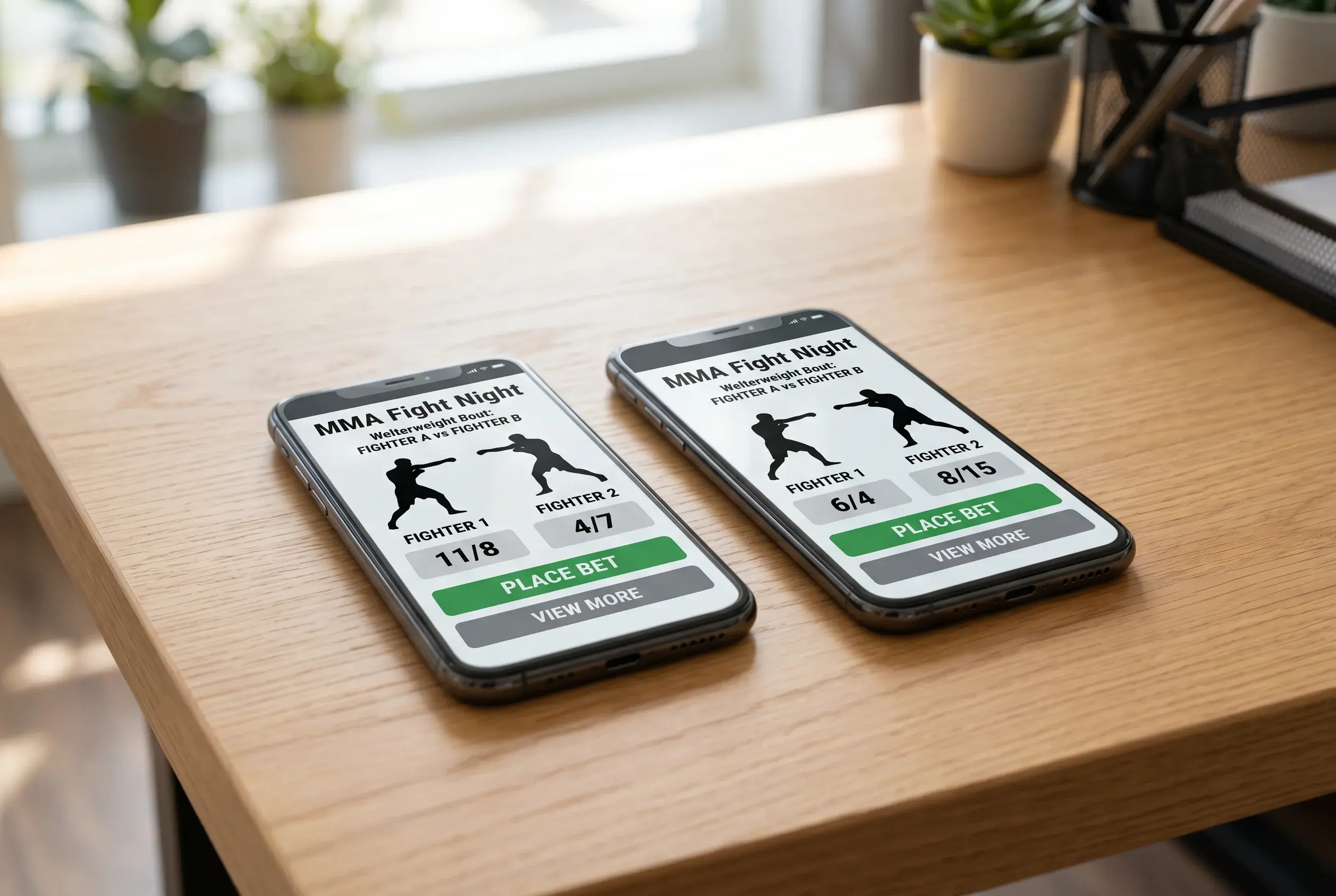
Here is a small confession. The first time I tried to bet a UFC fight, I sat staring at a screen showing "1/2" next to one fighter and "7/4" next to the other, and had to open a calculator to work out which one was the favourite. If that sounds familiar, you are not alone — and the picture has gotten more complicated since, because UK sites now happily mix fractional, decimal and occasionally American odds across bet builder and accumulator tools.
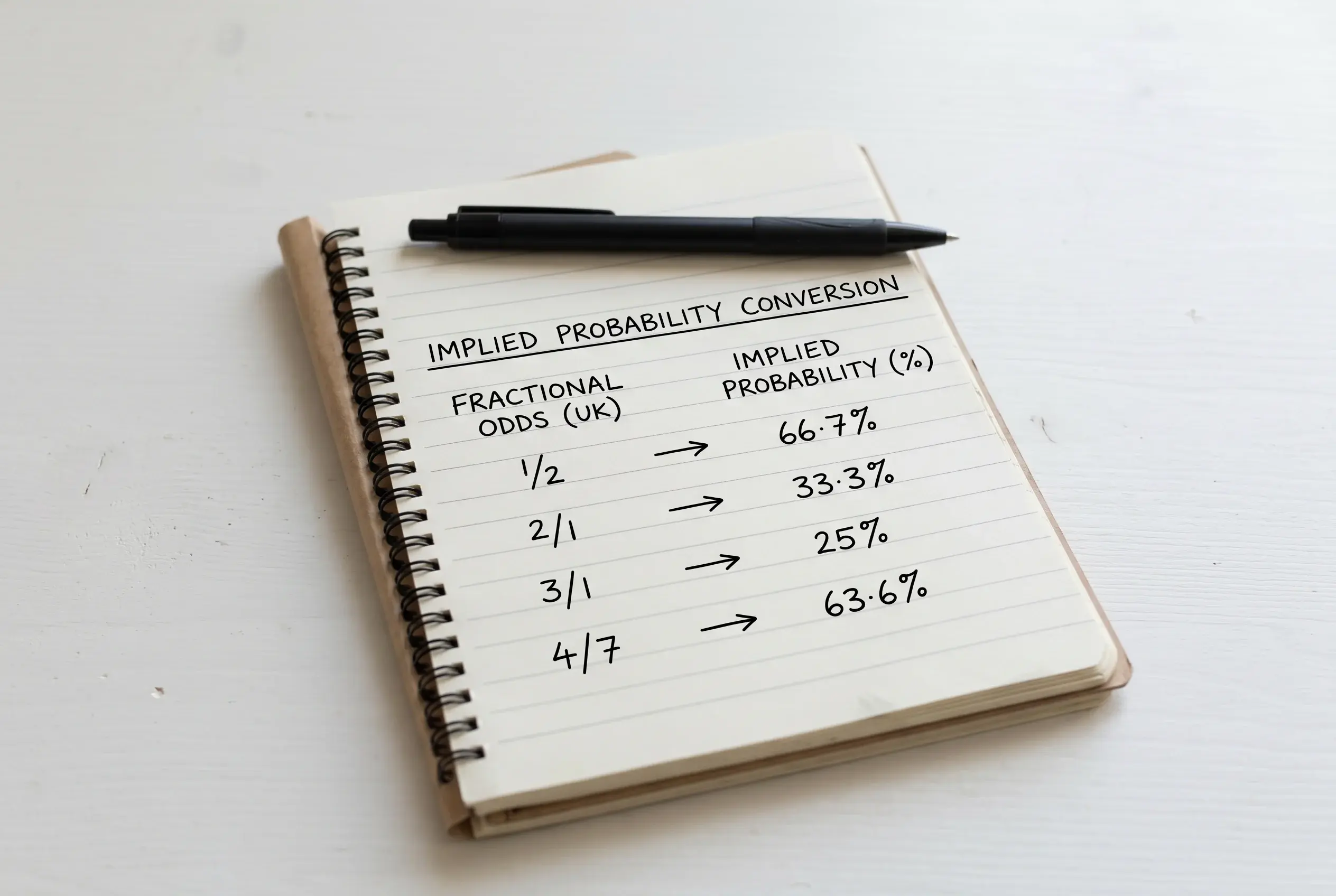
The good news: all three formats describe exactly the same probability. Once you can convert between them in your head, the screen of numbers stops being intimidating and starts being useful.
Fighter A: 4/7 fractional, 1.57 decimal, -175 American
Stake £10. Profit if Fighter A wins: £5.71. Total return: £15.71. Implied probability: roughly 64%.
Fighter B: 11/8 fractional, 2.375 decimal, +137 American
Stake £10. Profit if Fighter B wins: £13.75. Total return: £23.75. Implied probability: roughly 42%.
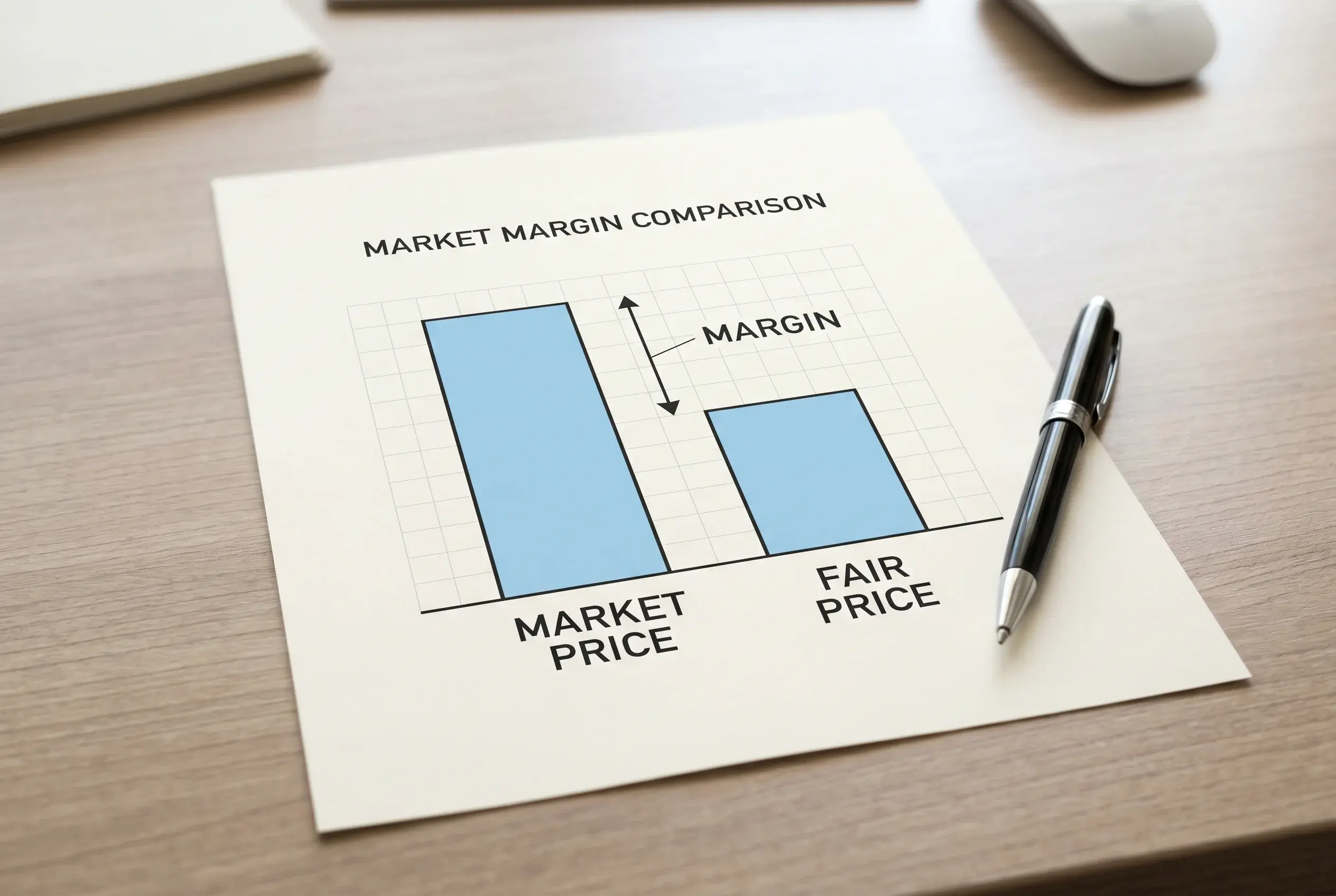
Notice that the two implied probabilities add up to about 106%, not 100%. That extra six percent is the operator's overround — the margin the bookmaker has baked in to guarantee they profit if action is balanced. Different books carry different overrounds, which is a polite way of saying the same fight can be priced differently across UK operators on any given Saturday night.
This is not theoretical. Research on the Fanatics and BetMGM platforms in 2024 found the same UFC fighter on the same date listed at +365 with one and +400 with the other. A meaningful difference if you bet seriously over time. Most casual punters never check more than one screen — fine if your weekly UFC stake is entertainment, but the single most preventable leak in a committed bettor's bankroll.
Calculating a return from fractional odds, step by step
Step 1: Take the fractional price. For 11/8, the first number is profit, the second is your stake unit.
Step 2: Divide the first by the second. 11 divided by 8 is 1.375.
Step 3: Multiply that result by your actual stake. £10 × 1.375 equals £13.75 profit.
Step 4: Add the stake back for total return. £13.75 plus £10 equals £23.75.
Step 5: To convert to decimal odds, add 1 to the fractional result. 1.375 plus 1 equals decimal odds of 2.375.
One more practical note. UK sportsbooks default to fractional odds for their primary fight market because that is what the British public is used to, but bet builder tools, in-play interfaces and accumulator calculators almost always switch you to decimal under the hood. If your screen suddenly shows "1.57" instead of "4/7", the site is rendering the same number in a friendlier format for multiplying out parlay legs.
Odds formats deep dive
For full coverage of fractional, decimal and American formats, implied probability conversion, overround and where each format appears, see our UFC odds guide for UK bettors.
Choosing a UKGC-Licensed Sportsbook for UFC
A friend texted me last summer with a screenshot. "This site has way better UFC odds than my normal one — should I use them?" I asked the one question that mattered. "Does the footer say they hold a UK Gambling Commission licence, and does the number match the register?" The answer, predictably, was no. The site looked the part: slick app, GBP accepted, sleek welcome offers, prices that would make you look twice. Entirely outside the protections the UK regulatory system spent fifteen years building.
Choosing where to bet on UFC in 2026 is mostly binary. Either an operator carries a current UK Gambling Commission licence — which means they are subject to the entire framework described above, from financial vulnerability checks to deposit limit prompts — or they do not, in which case you have no real recourse when things go wrong. No middle ground.

That black-and-white framing matters because the shadow market is large and growing — and we will look at the scale of it properly later. For now, the operational reality is simple: there is the licensed world, and there is everything else, and your wallet only has full protection inside one of them.
"What we are seeing is a harmful black market scaling up at pace. Illegal operators are becoming more sophisticated, more visible and more aggressive."
Grainne Hurst, Chief Executive, Betting and Gaming Council
I am not going to name names of operators I trust, and I will be transparent why: this guide does not exist to rank books, take referral revenue, or push any particular brand. What I can give you is the framework I use to vet a sportsbook before depositing a pound — five minutes of work that protects you from the entire offshore problem.
Five checks before you trust a UFC sportsbook with your money
- Find the operator's footer. A UK Gambling Commission licence number, operating licence number and named licensed entity should be visible. If any is missing, walk away.
- Look that licence number up on the public UKGC register. The listed entity should match what appears on the operator's footer.
- Check the domain spelling. Offshore copies of UK brands often differ by a letter or use a variant suffix like .co or .net.
- Look for a prominently displayed responsible gambling tools page — deposit limits, time-outs, self-exclusion, GamCare link. Licensed operators must provide these.
- Read the cashier page before depositing. Withdrawal terms, KYC requirements and dispute resolution should link to a UKGC-approved alternative dispute resolution service.
✓ Do
- Open accounts only with operators whose UKGC licence you have personally verified on the public register.
- Set deposit and loss limits during sign-up, while still calm and rational.
- Treat any welcome offer as a small bonus, not the reason to choose a site.
- Keep one or two trusted accounts rather than scattering balances across many.
✗ Don't
- Click through to a "UFC betting site" from a stream on a sketchy aggregator page.
- Assume a slick app or recognisable logo equals UK licensing.
- Hand over identification documents to a site you have not verified.
- Chase an unusual price boost from an offshore book without asking how they can afford it.
The 2026 rulebook in detail
For the full breakdown of what a UKGC licence entitles you to in 2026 — statutory levy, financial vulnerability checks, dispute resolution — see our coverage of UKGC-licensed UFC sportsbooks.
Reading a Fight Like an Analyst, Not a Fan
The trader who first trained me on UFC pricing used to repeat the same line. "Forget who you want to win. Tell me who the data says will win." It sounds obvious. In practice it is the single hardest mental shift a UK punter has to make. We all watch the highlight reel before we open the price page. The fighter we love feels like better value than the one we do not. That feeling is wrong, consistently.
There are five core fighter metrics every serious UFC bettor needs to internalise. Not secret, not paywalled, listed on every fight preview page worth reading. Strikes Landed per Minute (SLpM) tells you how active a fighter is in stand-up. Striking Accuracy is the percentage of attempted strikes that land. Strikes Absorbed per Minute (SApM) reports the same from the other end. Defence Percentage shows how many incoming strikes are avoided. Takedown numbers complete the grappling picture. Compare two fighters across these five before you bet and you are ahead of the casual market.

The next layer up is divisional baseline. Favourites do not win at the same rate across every weight class. Across UFC history they win roughly 68% of fights; in 2024 they covered at 72%. Dig into individual divisions and the spread is wider. Men's flyweight since 2020 produced a favourites record of 30 wins, 8 losses and 1 draw — a 77% strike rate that towers over the UFC average. Heavyweight, where one clean punch can rewrite a fight, is markedly more volatile.
Of the 19 fighters who have won a UFC title as underdogs, 12 successfully defended that belt at least once — a 63% retention rate that contradicts the lazy "lucky shot" narrative. When an underdog champion fights again, the market sometimes overcorrects toward the new favourite. A window to watch.
Now we get to the most underrated factor in the whole exercise: weight cutting. Serious biomechanical research shows UFC athletes lose an average of 6.7% of total body mass in the 72 hours before the weigh-in, then put roughly 9.7% back on within 24 to 36 hours of stepping off the scales. The bigger the cut, the higher the chance something goes wrong on fight night — gas tank evaporates in round two, chin gets fragile, recovery between rounds breaks down. Repeat weight missers carry warning lights in my own model that move them down the win-probability ladder even when the bookmaker keeps them as favourites.
The fighters themselves know. Deiveson Figueiredo, who held two divisional titles in his career, was unusually candid after a defeat — saying flatly that the weight cut was the problem, that he left the hotel feeling very bad, and knew before the fight that it was not his day.
Tom Aspinall, the current UFC heavyweight champion, holds the record for the shortest average fight time in UFC history at 2 minutes 18 seconds. That single number reframes how you price any of his three-round bouts, especially over-under rounds and round-one finish markets.
The aim is not to predict a single fight with certainty — that is impossible. The aim is to make your subjective view less subjective and your stake decisions more grounded. The market is mostly efficient. Your edge lives in the corners.
The analyst's toolkit, expanded
For the deep methodology — five core metrics, weight class divergence, style matchups, weight cut physiology, and short-notice fights — see our data-driven UFC fight analysis guide.
Live and In-Play Betting on UFC Fights
The fight had been one-sided for nine minutes. Then a single clean elbow opened a cut over the favourite's eye between rounds, the doctor took longer than usual on inspection, and across every UK in-play market the prices flipped before the bell rang for round three. That ninety-second window is when in-play betting on UFC actually pays its way. Not as a constant flow of micro-bets, but as a tool for capturing moments where the picture genuinely changes.
In-play, also called live betting, accounts for a meaningful chunk of the £596 million real event betting GGY UK operators booked in Q4 2024/25. UFC is one of the most intense live betting products — short rounds, big momentum swings, frequent market suspensions, a final price that can move five lengths in the space between a clinch and a takedown. Not comfortable for casual punters. Also why the market exists.
Between rounds, every operator reprices everything: moneyline first, then Method of Victory, then Round Betting, then the bet builder legs you might have queued. If you watch on TNT Sports — still the UK rights holder for the Paramount-era calendar of 13 numbered events and 30 Fight Nights — latency runs typically 20 to 40 seconds between cage and screen. Sportsbooks update from a low-latency data feed before your stream catches up. That gap matters. It is the main reason live markets get suspended even when nothing visible is happening: the book has data you do not.
"Many black market sites specifically target the most vulnerable, including those who have self-excluded from regulated betting firms."
Betting and Gaming Council, on the risks of in-play betting outside the regulated ecosystem
Cash out is the other in-play feature worth understanding. It lets you settle a bet for less than full value before the result is known — locking in profit on a winning position, or salvaging part of a stake on a losing one. Whether it is smart use of your money depends on whether the operator's cash-out price is fair or weighted toward them, and that varies more than you might think.
One firm rule I follow: never bet in-play on a fight you have not analysed pre-fight. The pace is too fast for genuine analysis on the fly. In-play is about acting on a view I already formed.
In-play and bet builders in full
For live markets, between-round pricing, cash out mechanics, bet builder combinations and TNT Sports broadcast latency, see our UFC live betting and bet builders guide.
Bankroll Management and Keeping UFC Betting Sustainable
I have a personal rule that has saved me more money than any tipping service or analytics model: if I cannot tell you, off the top of my head, what my UFC bankroll is at this exact moment, I should not be placing a bet tonight. Not glamorous. It is also the single difference I have seen between the punters still betting calmly five years later and the ones who quietly disappeared.
The basics are not complicated. Decide in advance, in a calm moment, what amount of money you can lose without it affecting anything that matters in your life. That number is your bankroll. Anything above it is not yours to bet with. Set a unit size — one to three percent of bankroll is what most professional bettors use — and refuse to exceed it. Stake the same unit on a £1.50 favourite as on a 5/1 underdog. If you cannot bet the underdog with the same unit, you are letting emotion override sizing.

Eight percent of young people aged 11 to 17 in the UK reported some form of online gambling in the past 12 months in 2025. Four percent of teenage boys had bet on a sportsbook site or app, against two percent of girls. The numbers are an uncomfortable reminder that the entry age for betting habits is younger than the legal minimum. The way you talk about your own UFC betting at the dinner table is part of the picture.
The 2025 reforms changed the toolset available. Every UK-licensed sportsbook now prompts new customers during sign-up to set a financial limit. Existing customers can adjust those limits at any time, though raising a limit takes longer than lowering one — by design, to give you a cooling-off window. Use these tools.
✓ Do
- Pick bankroll and unit size before fight week starts, while the card is just an idea on a page.
- Track every UFC bet you place in a simple spreadsheet or notebook.
- Take a break if a single fight result has noticeably affected your mood the next day.
- Reach out to GamCare or talk to someone you trust if betting stops feeling like entertainment.
✗ Don't
- Chase a losing session with larger stakes on the next fight.
- Borrow money, in any form, to fund a UFC bet.
- Treat a welcome offer as house money to fire at long shots — it is still your money once you have wagered it.
- Open a second account at a different operator to bypass a deposit limit you set yourself.
One last note. The 2025 framework also gave UK bettors a much stronger self-exclusion mechanism — a one-button option that holds across every UKGC-licensed operator simultaneously, not just the site where you activated it. That is the single most underused protection in the regulated industry. Worth knowing it exists.
Why the Black Market Is Not a Shortcut
Three years ago a reader emailed me from somewhere in the Midlands. He had placed a four-figure UFC parlay at an offshore sportsbook, won, and could not withdraw. The site stopped responding to support tickets. His deposit card gave him no chargeback rights because the operator was outside the UK regulatory perimeter. Nothing I could tell him would get his money back. I have had versions of that conversation enough times to know that offshore betting is not abstract risk talk — it is a steady drumbeat of bad outcomes the headline numbers do not fully capture.
The scale is what should worry every UK UFC bettor. The unregulated betting market turned over £16.6 billion in 2025, up from roughly £5 billion in 2019. The regulated sector's share of UK gambling activity has fallen from 97% in 2019 to 92% in 2025. About 500 unlicensed sportsbooks and casinos actively target British customers, promoted by over 1,100 affiliate sites. WARC forecasts unlicensed operators will reach roughly half of all UK gambling advertising within two years if current trends continue.
"The choice for policymakers is clear. If the regulated sector becomes harder to use or less competitive, customers will not stop betting — they will simply go elsewhere."
Grainne Hurst, Chief Executive, Betting and Gaming Council
Where do these offshore sites find customers? The data is uncomfortable. In the first half of 2025, the UK saw 1.6 billion views of more than 90 seconds of illegal streams of the top ten sports. Eighty-nine percent of those views were accompanied by gambling advertisements from unlicensed operators. The pipeline runs: free stream → in-stream ad for an offshore book → click → register → deposit. Seamless from the consumer's perspective. A trapdoor from the protection perspective.
The campaigners who track this market do not mince words. Derek Webb of the Campaign for Fairer Gambling has called the UK "a soft touch" where online gambling operators were allowed to stay offshore under the original 2005 framework, linking the offshore footprint to organised criminality importing itself into British sport.
What does this mean for your next UFC bet? If you bet with a UKGC-licensed operator, none of the offshore problem applies. Your funds are protected. Disputes have a resolution path. Self-exclusion is enforced across the licensed industry. Cross into an offshore site and all of that disappears. There is no version of the trade-off where "slightly better odds at a lookalike site" is worth that exposure — and the trade-off is often illusory, because offshore books frequently pay long odds they never have to honour.
The 2026 UFC Calendar and UK Broadcast Reality
One question I get every January is whether the Paramount deal in the United States has affected how UK fans watch UFC. The short answer is no. The 2026 calendar features 13 numbered events and 30 Fight Night cards under the new agreement paying UFC an average of $1.1 billion per year over seven years. Crucially for British viewers, TNT Sports retains the UK broadcast rights. Same channel, same studio team, same Saturday-into-Sunday rhythm, same lag of roughly thirty seconds between the cage and your screen.
The calendar shape changes how you plan around UFC betting. The numbered cards — UFC 305, UFC 306 and the rest — are where the biggest names tend to fight, where bookmakers offer the deepest market lists, and where in-play liquidity is most reliable. Fight Night cards are smaller — shorter undercards, thinner prop markets, softer opening lines that occasionally hide value if you do your homework.
British events deserve a mention. UFC 304 at Co-op Live in Manchester on 27 July 2024 drew a paid attendance of 17,907 and generated a ticket gate of $6.72 million — a commercially successful fight card that turned its host city into a major MMA destination for the weekend. When the promotion comes to the UK, markets behave differently: more British prop interest, more parlays involving home fighters, more local money chasing the favourite.
The single largest UFC underdog ever to win a fight was Shana Dobson at +950 against Mariya Agapova (-1400) in 2020. A £10 stake on Dobson returned £105. Lines like that are vanishingly rare, but they remind you why moneyline pricing is asymmetric for a reason — and why the smart play is rarely to chase the biggest number on the screen.
If you are mapping out your 2026 UFC betting year, build engagement around the numbered cards and the UK-hosted shows, treat Fight Night weekends as smaller-scale events where you bet less and study more, and ignore the temptation to bet midweek cards from regional promotions you do not follow closely. The volume of fighting on offer is unprecedented. Discipline about which weekends actually deserve your attention is half of bankroll management.
Frequently Asked Questions About UK UFC Betting
Are UFC betting sites legal in the UK?
Yes, provided the operator holds a current UK Gambling Commission licence. Any sportsbook taking real-money bets from UK customers must be UKGC-licensed and comply with the 2025 rule set — financial vulnerability checks, statutory levy, deposit-limit prompts, per-product marketing consent. Sites taking GBP without that licence operate outside UK law, and customers using them have no protected dispute path. Verify the licence number against the public UKGC register before depositing.
What is the difference between fractional, decimal and American odds for UFC?
All three describe the same probability in different presentations. Fractional (4/7) shows profit relative to stake — £4 profit on every £7 staked. Decimal (1.57) shows total return per pound staked, including the original stake. American (-175 for favourites, +137 for underdogs) shows how much you stake to win 100 or how much you win from a 100 stake. UK sites default to fractional in their primary fight market and decimal inside bet builders. American odds typically appear only in US media coverage.
What are the main UFC betting markets I should know about?
The foundation is Moneyline — who wins regardless of how. Method of Victory adds the way they win: KO/TKO, submission, decision. Round Betting picks the exact round of the finish. Total Rounds Over/Under sets a half-round line. Fight to Go the Distance is a binary on whether the fight reaches the final bell. Prop bets cover specials like Performance of the Night. Outright and Futures cover championship paths over longer horizons.
How is a UFC bet settled if the fight is ruled a No Contest?
A No Contest — usually from an accidental foul like an eye poke, or a failed post-fight drug test — almost always voids most markets and returns the stake. Moneyline, Method of Victory, Round Betting and Total Rounds bets typically void. Operators publish precise grading rules in their UFC market terms, and when these differ between operators, the UKGC alternative dispute resolution route exists for that disagreement.
Is in-play (live) betting available for UFC fights in the UK?
Yes, and it is one of the most active live betting products on the UK market. UKGC-licensed sportsbooks offer in-play UFC markets that reprice between rounds, with cash-out on most singles and some bet builders. Markets are frequently suspended during active exchanges because the operator reacts to a low-latency data feed running ahead of your TV broadcast. The TNT Sports feed typically lags the cage by 20 to 40 seconds — which is why your sportsbook can suspend a market while your screen still shows nothing has changed.
What happens to my UFC bet if a fighter misses weight, withdraws or the bout becomes a catchweight?
It depends on the scenario. If a fighter withdraws and the fight is cancelled, bets on that bout typically void and stakes return. If a fighter misses weight but the fight goes ahead at a catchweight, most UK operators keep the moneyline and core markets live, though some title-fight specific markets void because the title is no longer on the line. If a replacement steps in late, bets placed before the replacement was announced usually void. Full grading rules live in the operator's published terms.
How can I keep UFC betting fun and avoid harm?
Decide your bankroll and unit size in advance, in a calm moment, and treat both as fixed. Use the deposit-limit prompts every UKGC-licensed operator now offers at sign-up. Track every bet in a simple log to see real performance rather than the memory-filtered version. Take a complete break if a fight result has noticeably affected your mood the next day. If betting starts to feel less like entertainment and more like a problem, GamCare and the National Gambling Helpline offer free, confidential support, funded partly through the new statutory levy specifically for that reason.
Where This Leaves a Thoughtful UK UFC Bettor
If you have read this far, you already have more structured knowledge about UFC betting in the UK than the average punter sitting next to you in the pub on a Saturday night. That counts for something. The sport is still growing — the global MMA economy is on track to hit $3.5 billion by 2030 — and the UK market wrapped around it is bigger, better regulated and more sophisticated than ever.
Two things to leave you with. First, the choice of where to bet matters more than the choice of what to bet. Stay inside the UKGC-licensed perimeter and you inherit the entire 2025 protection framework. Step outside and you are exposed to a £16.6 billion shadow market that has no obligation to you. Second, your edge as a UK bettor lives in the boring places — divisional baselines, weight cut signals, line shopping on the prelims. Not in the long-shot main-event parlay that pays 50/1.
UFC betting in the UK is a regulated entertainment product, not a shortcut to income. The bettors still here in five years treat it that way from day one — picking a UKGC-licensed home, setting limits before they care, studying fights as data exercises rather than fandom decisions, walking away from the offshore market entirely.