
Essential Responsible Gambling Tools for UK Punters
Every UK gambling operator licensed by the UKGC is required to make a specific set of responsible gambling tools available to every customer. The tools sit there in your account, often two clicks deep, often easy to forget about. Most UFC bettors I know have never used any of them. A smaller group have used one or two. A handful have used the full suite and consider the tools the most important infrastructure on their accounts.
The 2025 UK regulatory reforms tightened the requirements significantly. From February 2025, financial vulnerability checks became more systematic. From 31 October 2025, the updated Remote Technical Standards require operators to actively prompt customers to set financial limits and to make those limits easier to manage. The framework is genuinely consumer-friendly, but the friendliness only matters if you use the tools.
This piece walks through what’s available to UK UFC bettors, what each tool actually does, and which ones I’d suggest considering even if you’re betting at recreational stakes and have no concerns about your behaviour. The headline message is that these tools aren’t designed only for people in crisis – they’re designed to be useful for anyone who wants their UFC betting to stay within boundaries they consciously chose rather than drift based on whatever feels right on the night.
Deposit limits: the most underused tool that helps the most people
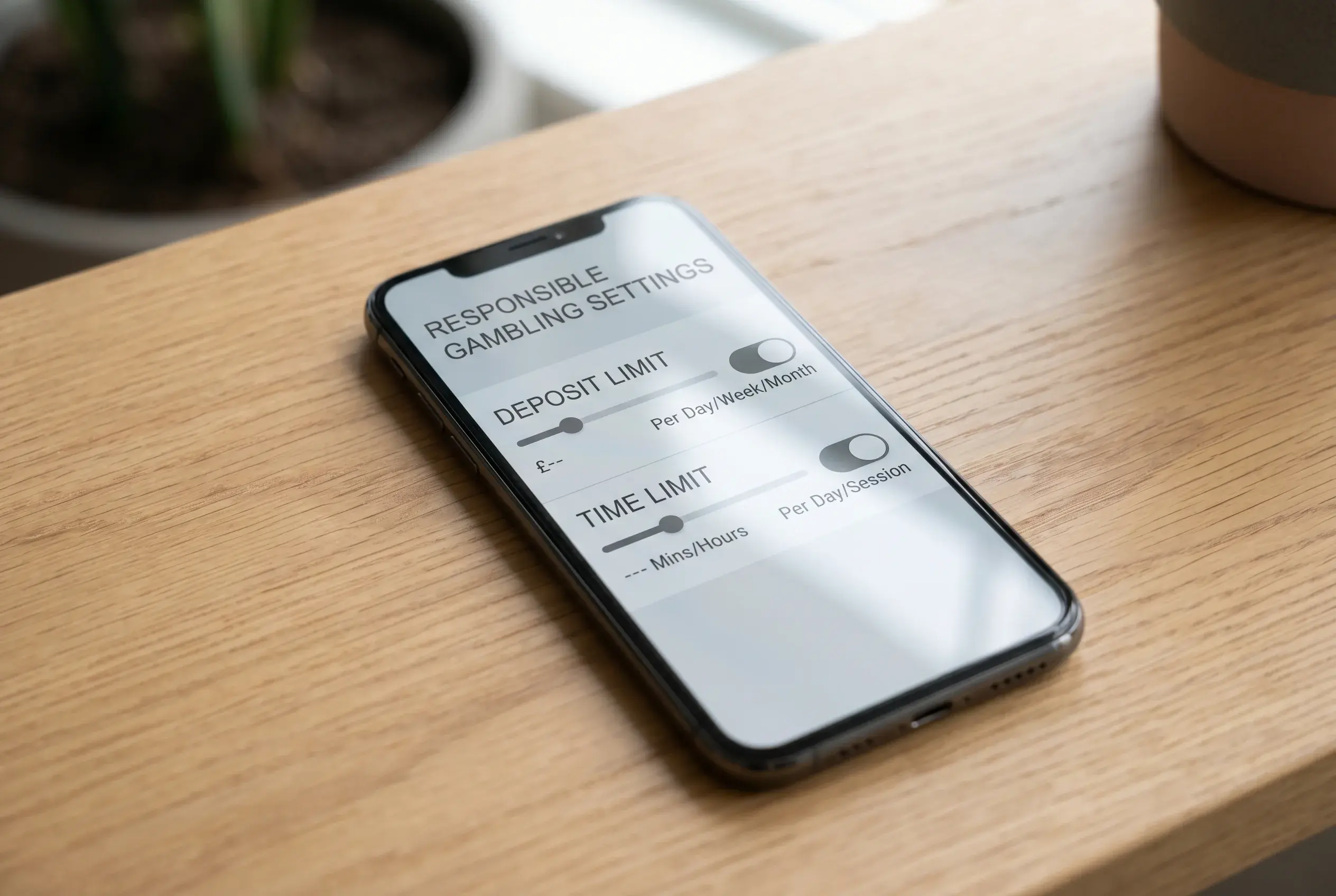
The deposit limit is the single tool I’d put first on the list. It caps how much money you can deposit into a sportsbook account over a chosen period – daily, weekly or monthly. Once you’ve reached the limit in a period, the account won’t accept further deposits until the period resets.
The mechanics on most UK operators are straightforward. You go into your account settings, find the responsible gambling section, set a limit, and confirm. The limit takes effect immediately. From the October 2025 RTS update, operators now actively prompt new customers to set a limit during sign-up rather than burying the option in settings.
The asymmetry on raising and lowering limits is worth knowing. Lowering a deposit limit takes effect immediately. Raising the limit, by contrast, requires a cooling-off period, typically 24 hours. The asymmetry is deliberate: it lets you tighten the rules without friction but creates a pause before you loosen them, which protects against impulsive in-session limit increases.
The practical effect of a sensible deposit limit on UFC betting is that it caps how much money your account can absorb across a card or across a year. If your sensible limit is £100/month and a Saturday night goes badly, the worst-case loss is bounded by what was already in the account. You can’t chase losses by topping up. The limit is the wall that protects you from yourself in the moments when self-protection is hardest.
Loss limits: capping the bad nights specifically
Loss limits sit alongside deposit limits but work differently. A loss limit caps the net amount you can lose over a chosen period rather than the gross amount you can deposit. If you set a £100 weekly loss limit and you’re down £100 net for the week, the account stops accepting further wagers until the period resets.
The advantage over a deposit limit is that loss limits track your net position rather than just gross deposits. A bettor who deposits £200 in a week but withdraws £150 in winnings is at £50 net loss – the loss limit captures this correctly while a deposit limit would have triggered on the gross £200 figure even though no real loss occurred.
The disadvantage is that loss limits can be gamed in ways deposit limits can’t. A bettor who’s down £100 on Tuesday at a £100 loss limit but who picks up a £50 win on Wednesday now has £50 of headroom to lose again. Most UK operators offer both tools, and the combined approach – a deposit limit at one level and a loss limit at a tighter level – is the most protective configuration.
Time and session limits: the structural intervention
Time-based limits cap how long you can spend on a sportsbook account in a given period, or trigger reminders after a chosen duration. The intent is to interrupt the kind of extended session where a UFC card stretches from prelims to post-fight press conference and the bettor stays logged in throughout, placing bets that wouldn’t have happened with breaks.
The mechanics differ by operator. Some implement hard time-outs – after a set number of hours active in the account, the account locks for the rest of the period. Some implement soft reminders – a pop-up after X hours offering a “take a break” option without forcing one. The hard version is more disciplined but feels intrusive; the soft version is gentler but easier to ignore.
For UFC specifically, the relevant session pattern is the Saturday night card. A four-hour card with prelims and main card produces three-plus hours of continuous engagement opportunity, during which the temptation to bet additional fights mounts. Session limits that prompt a break after two hours, even soft ones, sometimes prevent the late-card impulse bets that account for a meaningful share of unplanned losses.
Self-exclusion: the harder option that exists for a reason
Self-exclusion is the most serious tool and the one most often associated with gambling harm rather than recreational discipline. You self-exclude when you’ve decided you should not be gambling for a specific period – typically six months, one year, or indefinitely – and you want a structural barrier to enforce that decision against your future self.
The mechanics are uniform across UK operators. You request self-exclusion, the operator confirms, and your account is locked for the chosen period. You can’t reopen it, can’t deposit, can’t place wagers. The locks are typically enforced more strictly than other tools because the whole point is that you’ve decided you shouldn’t be able to circumvent the restriction.
The single-operator self-exclusion has an industry-wide complement: GAMSTOP. This is the UK-wide self-exclusion register that all UKGC-licensed operators are required to honour. Registering with GAMSTOP excludes you from every UKGC operator simultaneously for the chosen period. For bettors who’ve recognised that their UFC betting (or any gambling) has moved beyond what they want it to be, GAMSTOP is the strongest available tool in the UK framework. It exists because individual willpower fails in predictable ways, and the structural barrier doesn’t require willpower to maintain.
Cooling-off periods: the temporary intervention
Cooling-off periods sit between session limits and self-exclusion. They’re short-term account locks – typically 24 hours, 7 days, 30 days, or 90 days – that you can trigger at will. The account is locked for the chosen duration and you can’t bet, deposit, or access the account for normal use during that time. The lock typically can’t be reversed once activated.
The use case is the bettor who’s had a bad weekend and recognises that betting the following weekend isn’t a great idea. The 7-day cool-off prevents that follow-up session entirely. The other use case is the bettor who’s noticed that their betting is drifting in ways they don’t like – a 30-day cool-off creates space to think about whether the behaviour needs to change.
Most UK operators present cooling-off prominently. The October 2025 RTS update specifically required operators to make cool-off easier to access in account settings, reducing the clicks needed to activate. The friction to activating a cool-off is now lower than the friction to deactivating it once it’s running, which is the right asymmetry.
The 2025 reforms and what they actually changed
The UK regulatory reforms that took effect through 2025 changed the responsible-gambling framework in ways worth understanding because they affect every UFC bettor on a UKGC-licensed account.
The Gambling Levy Regulations 2025 took effect on 6 April 2025, establishing a statutory levy of 0.1% to 1.1% of operator gross gambling yield depending on the activity. The levy funds research, prevention and treatment of gambling-related harm – money that previously came from voluntary operator contributions. From 28 February 2025, online operators became required to conduct financial vulnerability checks more systematically. Light-touch checks happen at lower thresholds (typically £125 net losses in a single month or £500 net losses across 12 months); enhanced checks happen at higher thresholds where the operator has reason to think the customer may be experiencing harm.
From 1 May 2025, operators can only conduct direct marketing to customers who have explicitly consented per product (casino, bingo, betting) and per channel (SMS, email, post). From 31 October 2025, RTS updates required operators to actively prompt customers to set deposit limits and to make limit management more accessible – the prompting requirement is the biggest behavioural change for everyday bettors.
Setting limits that actually fit recreational UFC betting
The practical question is: if you want to set limits but you’re not in crisis, what numbers make sense for UFC betting specifically? The answer depends on your bankroll, your stake sizes, and your card cadence, but a few principles apply broadly.
The starting point is to think about your annual UFC betting budget – the total amount you’d be comfortable losing across a full year if every bet went badly. For most recreational bettors this number is between £200 and £2,000. Divide by 12 for a monthly deposit limit baseline. The figure should feel meaningfully restrictive – if it doesn’t, your annual budget number is too high relative to your comfort level.
For accumulator and bet-builder bettors specifically, a daily deposit limit lower than the weekly aggregate prevents the impulse to chase a losing accumulator with a top-up. The pattern of building an accumulator, watching it nearly hit, and immediately depositing again to bet on the next card accounts for a meaningful share of the avoidable losses I’ve seen recreational punters take.
The reality of these tools is that they only work if you set them when you’re not in the heat of a bad session. The good time to configure limits is on a quiet weekday afternoon when no UFC card is approaching. The bad time is in the middle of a Saturday night when you’ve lost three bets in a row and the next prelim is coming up. Setting the framework in advance is the entire point – the friction protects the future version of you that’s harder to negotiate with.
Mobile-specific responsible gambling features
Mobile sportsbook apps have additional responsible-gambling features that desktop sites don’t, and they’re worth knowing about because most UK UFC betting now happens on mobile rather than desktop.
Push notifications about responsible gambling are increasingly common – operators are required to send periodic reminders about tools available, current spend, and recent activity. Biometric authentication for high-value wagers is another mobile-specific feature; some operators require fingerprint or face authentication for bets above a chosen threshold, which adds a small friction that interrupts impulsive large stakes. Activity history on mobile apps is also more accessible than on desktop – most operators present a daily, weekly, and monthly summary of bets placed, total stakes, net result, and time spent on the app.
The mobile betting experience has its own dynamics that affect how punters bet, and understanding those dynamics is part of betting within sensible boundaries. The way UFC mobile betting apps shape UK betting behaviour covers the specific differences between mobile and desktop betting that affect everything from speed of placement to the way live markets are presented.