
Southpaw vs Orthodox Stance Angles and Betting Traps
About 18 months ago I started weighting stance matchups more aggressively in my UFC pricing model. The theory was straightforward – southpaw fighters have a structural advantage against orthodox opponents because of the open-stance angles, southpaws are underrepresented in MMA training (so orthodox fighters get less exposure to them), and operator models historically underprice the southpaw edge. The first few cards I bet on the new framework produced a clean run of wins, and I was ready to declare stance reading a major edge.
Then the next ten cards produced almost no signal at all. Southpaws won at roughly the rate the Moneyline implied. Orthodox fighters won the same. The “edge” I’d thought I’d found was a small-sample artefact, and the underlying truth turned out to be that stance matters in some specific matchups and not in others – and the bettor’s job is to know which is which, rather than to bet “southpaw vs orthodox” as a blanket pattern.
What the stance actually changes mechanically
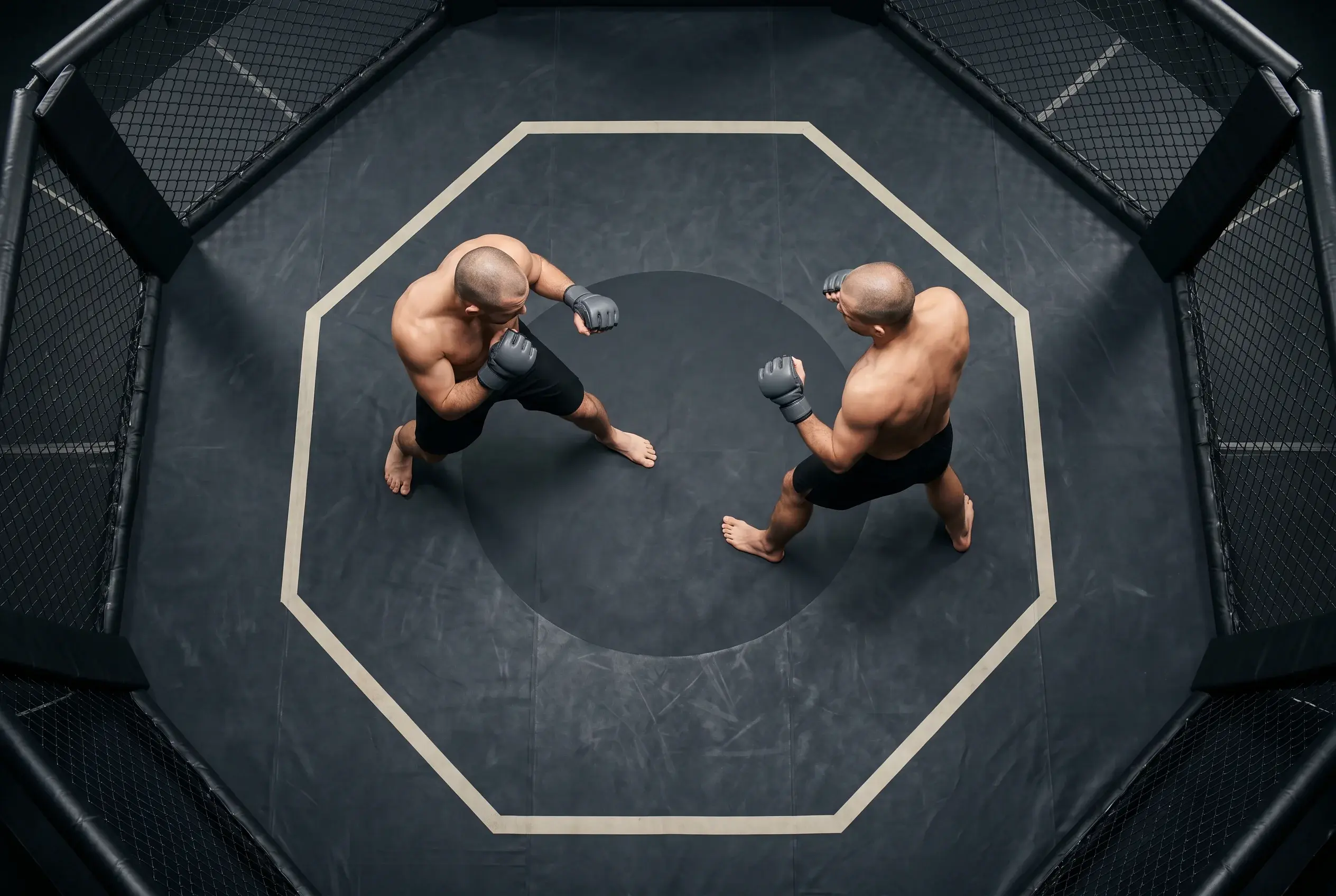
A fighter’s stance is the position of their lead foot. Orthodox stance has the left foot forward and right hand back; southpaw is the mirror image with right foot forward and left hand back. When two orthodox fighters or two southpaw fighters meet, they’re in a “closed stance” matchup – lead feet on the same side, rear hands obstructed from each other by their own lead arms.
When orthodox meets southpaw, the matchup is “open stance” – lead feet on opposite sides, rear hands directly available to each fighter’s centerline. The structural difference is that in open stance, the rear hand (the power hand) has a clearer path to the opponent’s chin without the obstruction of crossed lead arms. The lead leg is also exposed differently – the front leg of one fighter is in line with the rear leg kicks of the other.
These are real geometric differences that affect what strikes land and what doesn’t. A right-cross from an orthodox fighter against a closed-stance orthodox opponent has to come over or around the opponent’s lead arm. The same right-cross against an open-stance southpaw is a straight line to the chin. The mechanical advantage is real.
The opposite-stance advantage that often shows up
The cleanest expression of the open-stance dynamic is the southpaw left cross against orthodox opponents. The shot has a clear lane, lands frequently, and accounts for a disproportionate share of southpaw KO finishes in the UFC. Conor McGregor’s left hand, Israel Adesanya’s left straight against orthodox opponents, Dustin Poirier’s left hand – these are individual cases but the pattern is recurrent across the sport.
The orthodox response that works is the lead-leg calf kick. Open-stance positioning puts the orthodox fighter’s rear-leg kick directly into the southpaw’s lead leg, and the orthodox fighter doesn’t have to angle out to land it. The 2018-2022 era saw a significant rise in calf kick prevalence at UFC level, and the kick is particularly effective in open-stance because the geometry favours it.
The pattern that emerges is that open-stance fights tend to be higher-finish-rate fights – both fighters have cleaner lanes to land power shots, and the cumulative effect of either the southpaw left or the orthodox calf kick produces more decisive finishes than closed-stance fights of similar fighter quality. Over 1.5 rounds and method-of-victory KO bets often have value in open-stance matchups that they don’t have in closed-stance matchups of similar styling.
When the stance signal doesn’t predict
The trap is betting stance as a standalone signal. Open-stance matchups produce open-stance advantages for the fighter who exploits them, but the fighter has to actually exploit them. A southpaw who throws the left hand infrequently against orthodox opponents doesn’t generate the open-stance advantage – they’re a southpaw on paper but not in tactical reality. A southpaw who throws front-leg-heavy kick volume against orthodox opponents isn’t using the open-stance lane that the geometry creates.
The same applies on the orthodox side. An orthodox fighter who doesn’t throw lead-leg kicks doesn’t get the open-stance calf-kick advantage; they’re stuck managing the southpaw left hand without the structural counter that orthodox-vs-southpaw geometry offers. The stance doesn’t determine the outcome – the use of the stance does.
The reading requires watching fight tape, not reading stance labels. A southpaw with a left-hand focused offence (Adesanya, McGregor in 2014-2016) is one kind of stance matchup; a southpaw with a kick-heavy or grappling-focused offence is a different kind, and the open-stance dynamic doesn’t drive their fights in the same way.
The switch-stance complication
A growing number of UFC fighters switch stances mid-fight rather than fighting from one stance consistently. The motivation is to confuse opponents accustomed to facing a single look, and to create offensive opportunities by being unpredictable. Switch-stance fighters break the simple southpaw-versus-orthodox read because their stance varies within rounds.
The betting implication is that switch-stance fighters in operator pricing are often categorised by their predominant stance – usually orthodox if they spend 70%+ of their time in orthodox, southpaw if 70%+ southpaw – but the categorisation hides the tactical reality. A fighter who switches stance every few exchanges is functionally an “open-stance” opponent regardless of which stance their opponent fights from, because the matchup is always shifting.
For bettors, switch-stance fighters are typically harder to price reliably from stance considerations alone, and the stance signal should be deprioritised. The fight comes down to other factors – cardio, range management, individual technique – that the headline stance classification doesn’t capture.
How weight class moderates the stance signal
The stance effect doesn’t apply uniformly across weight classes. Heavyweight stances matter less because heavyweight outcomes are more often determined by individual power shots than by accumulated geometric exchanges – a single clean shot can end the fight regardless of stance positioning, and the open-stance versus closed-stance differential in finish rates is smaller because the baseline finish rate is high at heavyweight regardless.
The featherweight, bantamweight, and flyweight divisions show the cleanest open-stance advantage in historical data. These divisions feature high-volume striking exchanges where accumulated open-stance landings build into decisive fight-shaping advantages, and the technical precision of the lighter classes means the geometric advantages translate more cleanly into observable outcomes. Flyweight favourites’ 30-8-1 record since 2020 includes a notable concentration of open-stance victories where the geometric advantage was material.
The middleweight and welterweight divisions are intermediate cases. Some matchups show clean stance effects; others don’t, depending on individual fighter style. Reading the stance signal in these classes requires the matchup-specific analysis rather than a categorical assumption.
The market pricing of stance
UK operator models incorporate stance information, but with varying degrees of sophistication. The headline categorisation – fighter A is orthodox, fighter B is southpaw – is universally included. The next layer – open-stance versus closed-stance matchup – is also typically included. The third layer – fighter-specific tactical use of the stance, switch-stance frequency, opponent-specific stance adaptation patterns – varies in how heavily it’s weighted.
The pricing inefficiency tends to surface in the third layer. Operator models that classify a switch-stance fighter as “predominantly orthodox” don’t fully capture the fight-by-fight reality of how they actually engage. Sharp bettors who track the in-fight stance pattern of switch-stance fighters can identify when the operator’s stance read is off, and bet accordingly.
The other inefficiency is in younger fighters with limited UFC sample sizes. A fighter making their second or third UFC appearance with a notable stance preference may have that preference correctly identified but the tactical interaction with the specific upcoming opponent under-weighted in the model. The bettor who watches the previous fights and reads the stance interaction sometimes finds value the model hasn’t extracted.
The historical pattern that’s still useful
The largest single upset in UFC history – Shana Dobson defeating Mariya Agapova at +950 American odds in 2020 – was an open-stance matchup (Dobson southpaw, Agapova orthodox). The fight isn’t a clean example of stance driving the outcome (many factors contributed), but the stance dynamic was one element, and it’s a useful reminder that stance-based upsets happen and can be priced.
The broader historical pattern: open-stance matchups produce upset rates roughly 2-3 percentage points higher than closed-stance matchups of similar pricing. The difference isn’t enormous, but it’s consistent enough across years that the structural reasons for it – open lanes for power shots, geometric advantages in kicks – appear to be real rather than statistical noise.
For bettors looking for systematic value, the implication is that long-shot southpaws against favoured orthodox opponents have slightly more upset potential than the pure pricing implies, and the gap is most likely to surface when the southpaw has a notable left-hand offence and the orthodox opponent has any vulnerability to power-hand counters. These are specific conditions, not blanket rules. They’re worth tracking when they align.
What I actually do with stance reads
For each fight, I check three things. First, what stance each fighter usually fights from. Second, whether the matchup is open-stance or closed-stance. Third, whether each fighter’s tactical pattern actually exploits the stance geometry – does the southpaw throw the left hand, does the orthodox fighter throw the lead-leg kick, do they have the technical means to convert geometric advantage into observable damage.
If all three boxes tick for one fighter and only one or two tick for the other, the stance signal supports a lean. If both fighters tick all three boxes, the stance signal is neutral. If neither fighter genuinely exploits the matchup, the stance signal is noise. This is a small subset of fights, but it’s a real subset, and the matchups that tick all the boxes on one side tend to produce outcomes that align with the geometric expectation more reliably than aggregate stance statistics would suggest. The stance read combines naturally with judging tendencies, especially on decision fights where late-fight geometric advantage shapes scoring – UFC judging criteria and decision betting is the other half of that picture.