
Defining Unit Sizes and Fixed Staking Plans
When I first picked a unit size – 1.5% of bankroll, like every guide suggests – I assumed I’d bet exactly that unit on every UFC selection. A Moneyline favourite at 1/2? One unit. A long underdog at 5/1? One unit. A method of victory prop at 7/2? One unit. The instinct was clean and consistent, but it broke down on the first card I bet through using the system.
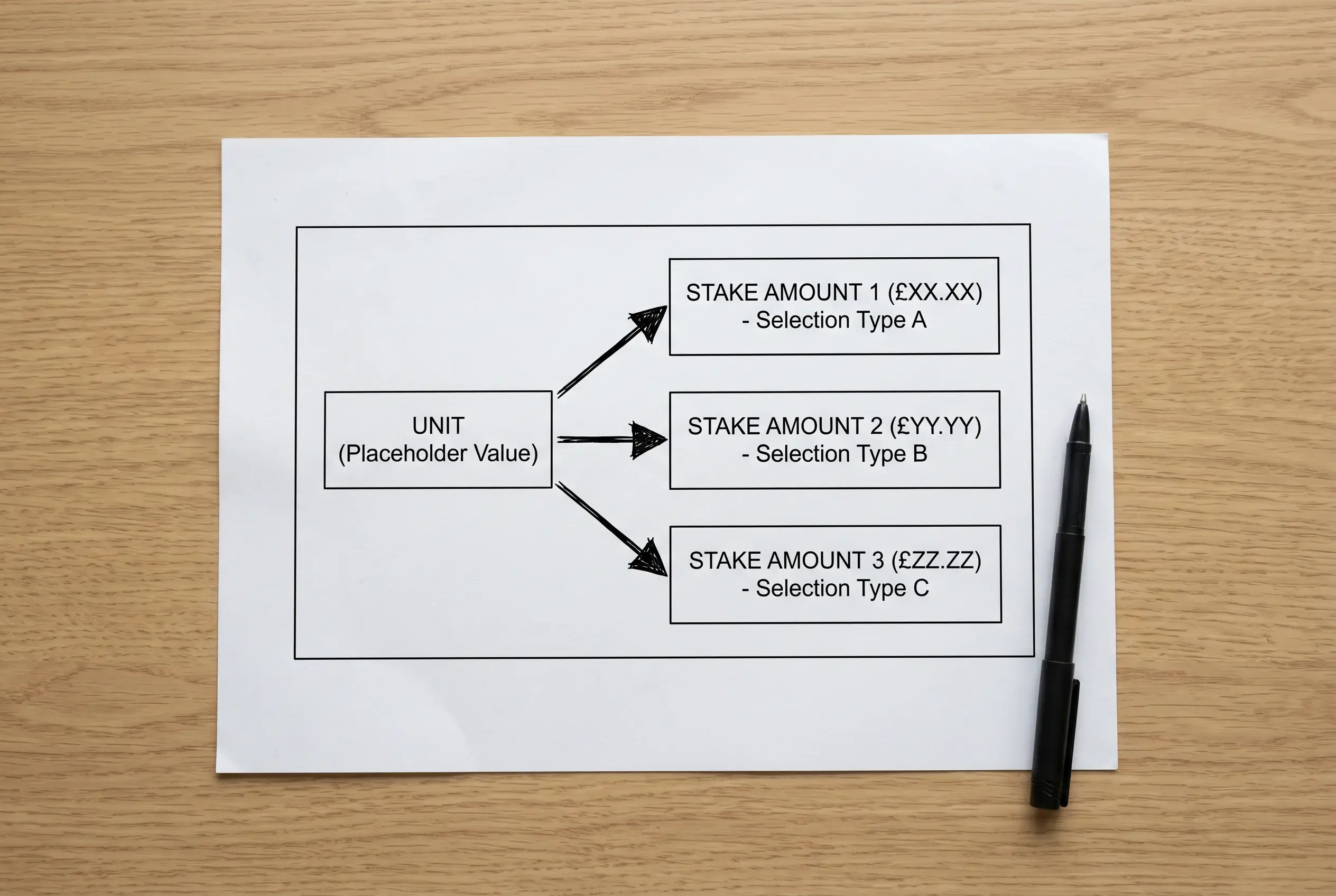
The breakdown wasn’t in the maths. It was in the recognition that “one unit” on a 1/2 favourite is a different bet from “one unit” on a 5/1 underdog in every way that matters – variance, expected value, hit rate, the role the bet plays in the overall portfolio. The staking framework that survived the next few months wasn’t fixed-unit-everywhere. It was a converter – a way of translating a unit size from a bankroll concept into specific bet sizes on specific UFC markets, with the conversion rules consciously designed.
What the unit actually represents
A unit is a bankroll-relative measure of exposure. The whole point of expressing bets in units rather than absolute pound amounts is that the bet’s significance scales with the bankroll. A £15 bet on a £1,000 bankroll has the same meaning as a £150 bet on a £10,000 bankroll. Both are 1.5%, both expose the bettor to identical proportional swings, both produce the same emotional reaction to a loss.
What the unit doesn’t represent – and what most staking discussions skip past – is the bet’s risk profile. A 1-unit bet on an even-money proposition has the same exposure as a 1-unit bet on a long shot only in the sense that the maximum loss is identical. The expected outcome distribution is completely different. The unit is a maximum-loss measure, not a return distribution measure.
This distinction matters because UFC betting markets span a wide range of risk profiles. Moneylines on short favourites are tight-distribution bets – you either win a small amount or lose your stake. Method of victory bets are wider – you either lose your stake or win 3-6 times your stake. Performance bonus bets are wider still – losses are common, wins are large multiples. Treating all of these as “one unit” implicitly treats them as the same bet, when they’re structurally different commitments.
The Moneyline conversion rule
Moneyline bets translate directly to unit size. One unit means one unit at stake – regardless of whether the price is 1/4 or 5/2, the stake is fixed at the unit size. The variation across favourites and underdogs shows up in the return profile, not the stake.
The reason this rule works for Moneylines specifically is that the Moneyline market is the highest-volume UFC market, the prices are tightly calibrated, and the bettor’s edge typically comes from finding spots where the price doesn’t reflect the true probability. The stake size doesn’t need to scale with confidence because the price already reflects probability. Betting one unit on a 1/4 favourite that you think should be 1/6 captures the edge proportionally; betting one unit on a 5/2 underdog that you think should be 7/4 captures a different but comparable edge proportionally.
What’s not allowed under this rule is “betting more on the favourites because they win more often”. Hit rate isn’t the determining factor for stake sizing – expected value is. UFC favourites win 68.12% of fights historically, but that hit rate is already priced into the favourite Moneyline. Betting bigger on favourites because they win more often is paying for hit rate that’s already in the odds.
The method of victory conversion
Method bets need a different sizing logic because the variance profile is wider. The convention I use – and that several practitioners I know also use – is to scale method stakes to 0.5 units when betting alongside a Moneyline on the same fighter, and to 1 unit when betting as a standalone position without a Moneyline.
The reasoning is correlation. If I bet 1 unit on Fighter A Moneyline and 1 unit on Fighter A by KO, I have 2 units of exposure tied to the same outcome – Fighter A winning. If Fighter A loses, I lose both bets. The combined exposure is bigger than the unit size suggests because the bets aren’t independent. Cutting the method stake to 0.5 units keeps the combined fight-specific exposure at 1.5 units, closer to the equivalent of a single Moneyline bet.
The standalone method bet – without a Moneyline on the same fighter – gets full unit size because the exposure is no longer correlated with another bet on the slate. A 1-unit method bet on Fighter A’s specific method, with no Moneyline backing it up, is structurally similar to a Moneyline bet in terms of how it sits in the overall portfolio.
The round and total conversion
Over/under rounds bets are a third category. The variance is moderate – wins and losses are roughly equally distributed by definition of a balanced market – but the correlation with other fight-specific bets is substantial. Betting over 2.5 rounds correlates with betting “fight to go the distance”; betting under 1.5 rounds correlates with method-of-victory KO bets.
The conversion I apply is 0.75 units for a standalone rounds bet, scaling down to 0.5 units if I’m also betting a correlated market on the same fight. Two units of total exposure on one fight is the structural cap I described in the bankroll piece – round bets contribute to that cap proportionally.
The case for going lower than 1 unit on rounds bets is that the markets are tightly priced. UK operators’ round/total models are well-tuned, and the value gaps that justified bigger stakes in earlier eras have narrowed. A unit-sized bet on every round line you find slightly attractive will produce a high-volume, low-edge portfolio that bleeds margin to the books over time. The 0.75-unit scaling reflects the reality that round bets are usually edge-thin rather than edge-rich.
Long-shot props and the half-unit rule
Performance bonus props, specific finish-time props, and other long-shot UFC markets get a hard half-unit cap. The reasoning is that long-shot variance is brutal. A 10/1 prop bet that hits returns 10 units; the same bet missing 10 times costs 10 units. Hit rate at long-shot prices needs to be around 1 in 11 to break even at fair prices, and the operator’s overround means the effective break-even rate is closer to 1 in 14 or 1 in 15.
Sizing long-shot props at full unit produces variance that wipes out the rest of the portfolio’s stability. The 5/1 underdog hitting once every six bets is fine if the bets are 1 unit each – wins are 5 units, losses sum to 5 units across the misses, the bankroll is roughly flat with high variance. The 10/1 prop hitting once every twelve bets is more problematic at unit size – wins are 10 units, losses sum to 11 units across the misses, the bankroll is bleeding even at marginal break-even hit rates.
Half-unit sizing on long shots makes the variance manageable. The trade-off is that the wins are smaller in absolute terms – 5 units instead of 10 – but the running portfolio is structurally healthier and the bettor can sustain longer testing periods to assess whether the long-shot edge is genuine before scaling up.
The bet builder and parlay conversion
Combined bets need their own conversion logic because the variance is multiplicative. A three-leg bet builder priced at 7/2 is roughly twice the variance of a single-leg bet at the same effective return. The conversion I apply for bet builders is 0.5-0.75 units depending on the leg count, with three-leg builders at 0.5 units and two-leg at 0.75.
Multi-fight accumulators on UFC cards – five fights across the prelims and main card – get tighter conversion still. A five-leg accumulator on UFC cards is mostly a long-shot bet whose return distribution mirrors a long-shot prop. The conversion is half-unit at maximum, and most experienced bettors would size them at 0.25 units or simply not bet them at all.
The reason combined-bet conversion deserves explicit rules is that combined bets are where most recreational bettors lose discipline. The temptation is to bet a four-leg accumulator at 1 unit because “it’s just one bet on the slip”, ignoring that the variance profile of that one slip is 8-10 times the variance of a single leg. The unit-size convention has to absorb the variance the slip structure introduces.
The card-level cap and how it ties everything together
On top of the per-fight 2-unit cap from the bankroll piece, I apply a card-level cap of 6 units total exposure across an entire UFC card. The reasoning is correlation again, but at a different layer – UFC cards have card-wide factors (judging tendencies of the panel, weather and altitude effects on cardio, broadcasting schedule effects on fight rhythm) that can affect multiple fights similarly.
A card-level cap of 6 units means I can structure exposure across roughly four to six fights on a typical 12-13 fight card. Some fights get full Moneyline-plus-method exposure at 1.5-2 units total. Others get a single market position at 0.5-1 unit. Others I skip entirely because I don’t have a strong enough read to justify a position. The skips are as much a part of the staking framework as the bets.
The 6-unit cap forces selection rather than coverage. The instinct on a stacked card is to find an angle on every fight, but a 13-fight card at 1 unit per fight is around 20% of a typical bankroll under a 1.5% framework – one bad card wipes out months of gains.
How unit discipline survives variance
The framework above is designed to survive long losing streaks without triggering recovery behaviour. A bad card where every bet loses costs 6 units – painful, but recoverable. A bad month with three or four bad cards in a row costs 18-24 units, closer to a fifth of the bankroll. Uncomfortable, not catastrophic. The system absorbs it and keeps functioning.
The variance you can’t survive is the variance you create by abandoning the framework. A 6-unit exposure on a card that ends 0-5 hurts; a 12-unit exposure on the next card to recover doubles the rate of decay if that card also goes badly. The discipline is not changing the unit size in response to recent results, in either direction.
The bettors I know who’ve been positive on UFC over multi-year horizons share one trait: their unit size today is essentially the same as three years ago, recalculated against the current bankroll. The framework is constant. Variance comes and goes. The bankroll trend reflects underlying edge, not recent cards. A complementary piece is reading the data behind the price – how UFC fighter statistics translate into bettable signal matters as much as how the unit is set.