
Tracking In-Play UFC Odds and Live Repricing
Round one of a UFC fight is 300 seconds long, and on a busy Saturday night with a stacked card the live odds on a single bout can move twenty or thirty times during that round. A clean takedown drops the wrestler’s price by ten percentage points of implied probability. A reversal sends it back. A knee from the bottom that lands flush can shift the live price by more than any pre-fight news short of a full withdrawal.
That kind of volatility is why in-play UFC betting attracts a particular type of bettor – and why it punishes a different type. The market is fast, the operators’ models are reactive, and the difference between a sharp in-play bet and a chase bet is mostly in how the bettor processed the moment that just happened. This is a piece about what actually moves the price in live UFC markets, where the model lags create opportunity, and which in-play markets are worth taking versus skipping.
What the live model is actually doing
Every UK book offering in-play UFC betting runs a real-time model that updates implied probability based on observable events in the fight. The input variables are public – strikes landed, significant strikes by position (standing, clinch, ground), takedowns attempted and landed, control time, knockdowns, submission attempts – and the model assigns weights to each based on its historical correlation with outcome.
The model’s job is to convert observed events into an updated win probability for each fighter. That probability is then translated into live Moneyline odds, with the operator’s standard overround applied. Every UK operator’s live odds on the same fight are model outputs, not human judgement calls. The risk team intervenes only on edge cases – disputed events, technical issues, suspected delayed feeds.
The interesting thing about live models is what they don’t weight well. They’re excellent at processing volume metrics – strikes thrown, takedowns landed, control time – because those are easy to count. They’re worse at processing damage. A clean knockdown that doesn’t quite finish the round is captured in the model. A flush punch that visibly hurt the opponent but didn’t drop them is captured less well, because “visibly hurt” isn’t a clean input variable. The same applies to fatigue, body damage from accumulated leg kicks, and the subtle indicators of a fight tilting that experienced viewers pick up on before the volume statistics catch up.
This is where the model lag comes from. Volume statistics update in seconds. Qualitative reads on damage and momentum take 30-60 seconds to surface in the model, sometimes longer. That gap is the working window for sharp in-play UFC bettors.
The markets that lag the most and where to find edges
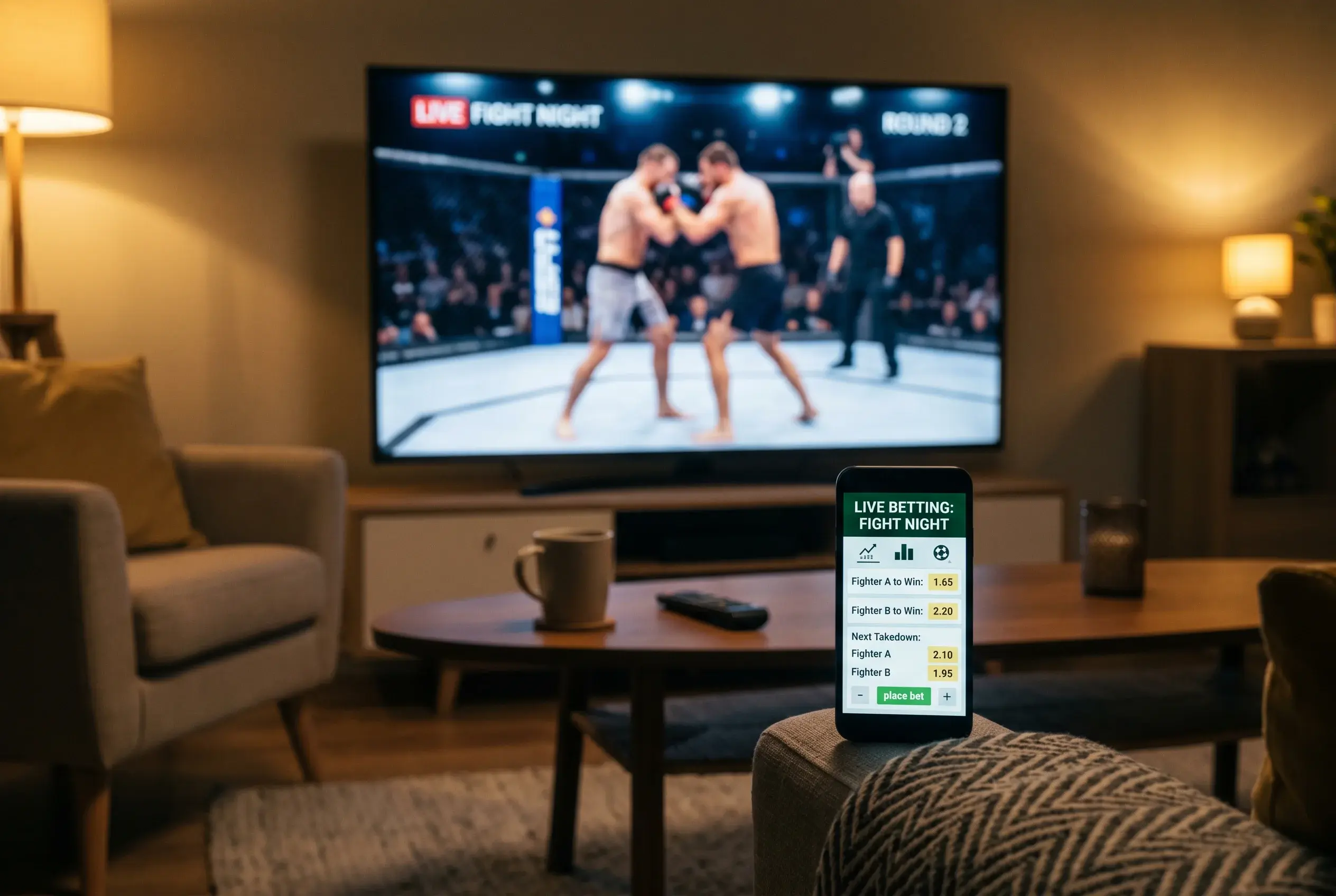
Live Moneyline odds move fastest because they’re the highest-volume market and the operators have the most data on them. By the time the broadcast cuts to commentary about a fighter being hurt, the live Moneyline has usually moved. The window for trading on volume-based events on the Moneyline is tight – often a single-digit number of seconds.
Live round-by-round odds – “Fighter A to win round 2” or “fight to end this round” – move slower and lag the underlying probability more. The model is updating a derivative market based on inputs from the main Moneyline, and the derivative is usually behind. When a fighter takes serious damage in the closing minute of a round, the live round market often hasn’t fully adjusted by the time the round ends. Sharp bettors who see the damage and bet “fight to end this round” on the back of it sometimes catch prices that under-reflect the current probability.
Live method of victory markets lag even more. “Fight to end by KO/TKO” updates based on the live Moneyline plus the recent strike volume and damage proxies, but the method-specific re-pricing is slower than the overall Moneyline shift. After a flush knockdown that doesn’t finish the fight, the method market often takes a noticeable beat to catch up to the changed picture. That beat is when sharp bettors trade method odds.
Live performance bonus markets – “fighter to win Performance of the Night” – are the slowest of all. The market is rarely high-volume enough for the operator to update it as aggressively as Moneyline or rounds. After a spectacular finish or a dramatic exchange that’s likely to win a $50,000 bonus, the bonus market sometimes still reflects pre-event probabilities for 60-90 seconds. The edge is small but consistent for bettors who track bonus market lag.
The bet sizing problem in live UFC markets
Live betting attracts smaller stakes than pre-fight betting at most UK operators, and stake caps are tighter. The risk team’s logic is straightforward – they’re pricing in real time off a model whose inputs are still settling, and they’re prepared to absorb less variance per bet than they would on a pre-fight market that’s had hours to converge.
The practical numbers vary, but typical UK operator behaviour is to cap recreational accounts at 30-50% of the equivalent pre-fight Moneyline limit when betting in-play. A customer who can bet £2,000 on a Fighter A pre-fight Moneyline might be limited to £600-1,000 on the same bet in-play, especially during high-volume moments like late in a round or immediately after a major event.
For sharp bettors trying to load up on a perceived edge, the limit is a real constraint. The workaround that some practitioners use is bet sizing across the round – placing smaller in-play bets at sequential prices as the round develops, rather than a single large bet at one moment. The approach distributes the bet across multiple operator stake-acceptance moments and accumulates total exposure that no single ticket could carry.
What freezes the market and what doesn’t
UK operators “suspend” live UFC markets – pausing bet acceptance – at specific moments. The standard triggers are: a knockdown, a submission attempt, a referee intervention, a doctor’s check, a clinch against the cage that’s about to be broken by the referee. The suspension lasts until the operator’s risk team has confirmed the outcome and updated the model, typically 10-30 seconds.
What doesn’t trigger a suspension is what’s most useful for in-play bettors to recognise. A clean shot that visibly hurts a fighter but doesn’t drop them rarely suspends the market – the model picks it up as significant-strike volume rather than as a knockdown event. A successful takedown into a dominant position that the operator’s algorithm doesn’t classify as submission-immediate doesn’t suspend. A cumulative pattern of damage – three rounds of consistent leg kicks adding up to a clear effect – never suspends, because no single event crosses the threshold.
The bet builder pattern in non-suspended moments is to look at what just happened, estimate where the live odds should be, compare to where they actually are, and bet the gap before the model catches up. The gap usually exists for seconds. The bettors who profit consistently from in-play are those who can process visual information about a fight faster than the model can process statistical information.
The streaming delay problem
UK punters watching UFC on the standard broadcast feed are typically 5-12 seconds behind the live action. That delay is real, and it matters enormously for in-play betting. If your broadcast is 8 seconds delayed and you bet a moment after seeing a takedown, the operator’s risk team has had 8 seconds – sometimes more – to update the live odds based on the actual event. The price you bet is the price the model has already settled at, not the price the moment justified.
Different streaming sources have different delay profiles. Cable broadcast delays in the UK have historically been 7-10 seconds. Streaming through UFC Fight Pass or other digital sources is sometimes faster, sometimes slower, depending on the route and the buffer settings. Reputable sports broadcasting operators have invested in delay reduction precisely because in-play betting volume incentivises it, but the delay never goes to zero.
For bettors trying to trade in-play edges seriously, knowing your own broadcast delay is a precondition. The simplest check is to compare your broadcast feed to the operator’s live data ticker – when the ticker updates strike counts or takedown attempts, compare to when you saw the event on screen. The gap is your operational delay and it sets the lower bound on how quickly you can ever react to in-fight events.
The in-play markets to skip
Not every in-play UFC market is worth playing. Live round betting – “Fighter A to win round 2” – at advanced rounds in a fight where you don’t have a clear read is mostly variance. The operator has solid models on round-by-round outcomes, the prices are typically efficient, and the implied probabilities reflect the live model’s reading of momentum reasonably well.
Live total significant strikes markets are another to be careful with. The operator’s model has tight historical data on strike volumes by weight class and fighter style. The lines tend to be well-priced, and the volatility within a round – strike rates can swing wildly between active and grappling exchanges – means individual round strike totals are high-variance bets relative to their expected value.
Live exotic markets like “fight to be stopped by punch versus elbow” or “winning fighter to celebrate with specific gesture” exist on some UK operators during high-profile cards. These are pure entertainment products with extremely wide margins built in. The bettor’s expected value is consistently negative, and the wide overrounds make even a strong read on the underlying probability difficult to convert into a positive return.
The live betting routine that actually works
Sharp in-play UFC betting doesn’t look like rapid-fire trading. It looks like watching the fight closely, noticing one or two moments where the live price hasn’t caught up to what just happened, and placing a single well-timed bet to capture the gap. Most rounds offer zero such moments. Some rounds offer one. A few high-action rounds offer two or three, and even then the windows are seconds, not minutes.
The bettors who do this well share a common pattern. They watch the fight on the lowest-delay feed available. They know each fighter’s tendencies well enough to anticipate which events the model will lag on – a known KO artist’s clean head connection generates a particular price reaction; a wrestler’s takedown completion generates another. They size their bets to operator stake limits rather than trying to bet more than the limits will accept. And they accept that most rounds will be spent watching, not betting.
This patience is what separates in-play traders from in-play gamblers. The market provides a small number of priceable moments per fight, and the operator’s edge over a chase bettor who’s clicking on every momentum shift is large enough to grind a bankroll down quickly. For bettors who want to engage with UFC betting at a higher tempo without the risk profile, a structured staking framework is the foundation – bankroll management for UFC betting is what makes in-play sustainable.