

Pricing Leg Correlations in UFC Bet Builders
The first time I used a bet builder on a UFC fight, I thought I’d found a loophole. I picked Fighter A to win, the fight to go the distance, and over 2.5 rounds. The price came back at around 7/2 – and all three legs felt like outcomes I’d happily back individually. I placed the bet, watched the fight play out almost exactly as I’d guessed, collected, and decided the bet builder was the most underrated product in UK MMA betting.
Then I started checking the implied prices against what the same three legs would have paid as a true parlay, and the picture changed. Bet builders aren’t a loophole – they’re a product priced to look generous on outputs that are heavily correlated, where a true accumulator would have been priced differently. Understanding what’s actually happening under the bonnet is what separates a bet builder you should take from one you should leave on the screen.
What a bet builder does that a parlay doesn’t
A standard parlay assumes every leg is independent. Multiply the decimal odds of each leg, subtract a stake-relative margin, and you have the parlay price. Independence is the engine – without it, the maths breaks because the outcomes are no longer separate events.
The problem with UFC parlays inside a single fight is that almost nothing is independent. If Fighter A wins by KO in round 1, the fight didn’t go the distance and the total was under 1.5 rounds. The legs are mathematically locked to each other. A true parlay engine would refuse the bet on those legs, because it can’t price correlated outcomes through simple multiplication.
A bet builder is a separate pricing layer. It looks at the joint probability of all the legs occurring together, builds an internal model of the correlation between them, and offers a single combined price. The output looks like a parlay – three legs on one slip – but the price isn’t a multiplication. It’s a model output.
That distinction matters because the bet builder’s correlation model is the operator’s edge. Sharp models on common combinations are tight enough that the prices are competitive. Loose models on rare combinations let the operator earn an outsized margin or, occasionally, leave value on the table. Knowing which is which is the bettor’s job.
The combinations UFC bet builders actually price well
Some leg combinations are common enough across UK books that the pricing has converged. Fighter to win plus method group (KO/TKO, submission, decision) is the obvious one – every operator running a UFC bet builder prices this combination, and the prices across books are usually within a few percent of each other. The correlation between “Fighter A wins” and “Fighter A wins by KO” is high, the joint probability is well understood, and the operators have priced it to volume.
Fighter to win plus over/under rounds is similarly tight. The correlation between a winning fighter’s finishing style and the round count is something every UK operator running an MMA book has had to model carefully, because the volume on combined Moneyline-plus-rounds bets is significant. Prices here tend to be efficient – meaning the value is in your read on the fighters, not in arbitrage between books.
Where bet builder pricing loosens up is in three-plus-leg combinations that touch low-volume markets. Fighter to win plus over 1.5 rounds plus performance bonus is a chain of legs the operator has to model with less reference data. The operator either prices conservatively – giving themselves an extra margin buffer because they’re unsure – or relies on a model with assumptions that may not hold for a specific fight. Both outcomes create opportunities for bettors with strong reads on the underlying probabilities.
How to read a bet builder price against true probability
The fundamental check is the same as for any other bet – does the implied probability match your estimate of the true probability of the combined outcome? The complication with bet builders is that you have to estimate the joint probability of multiple events, not just one.
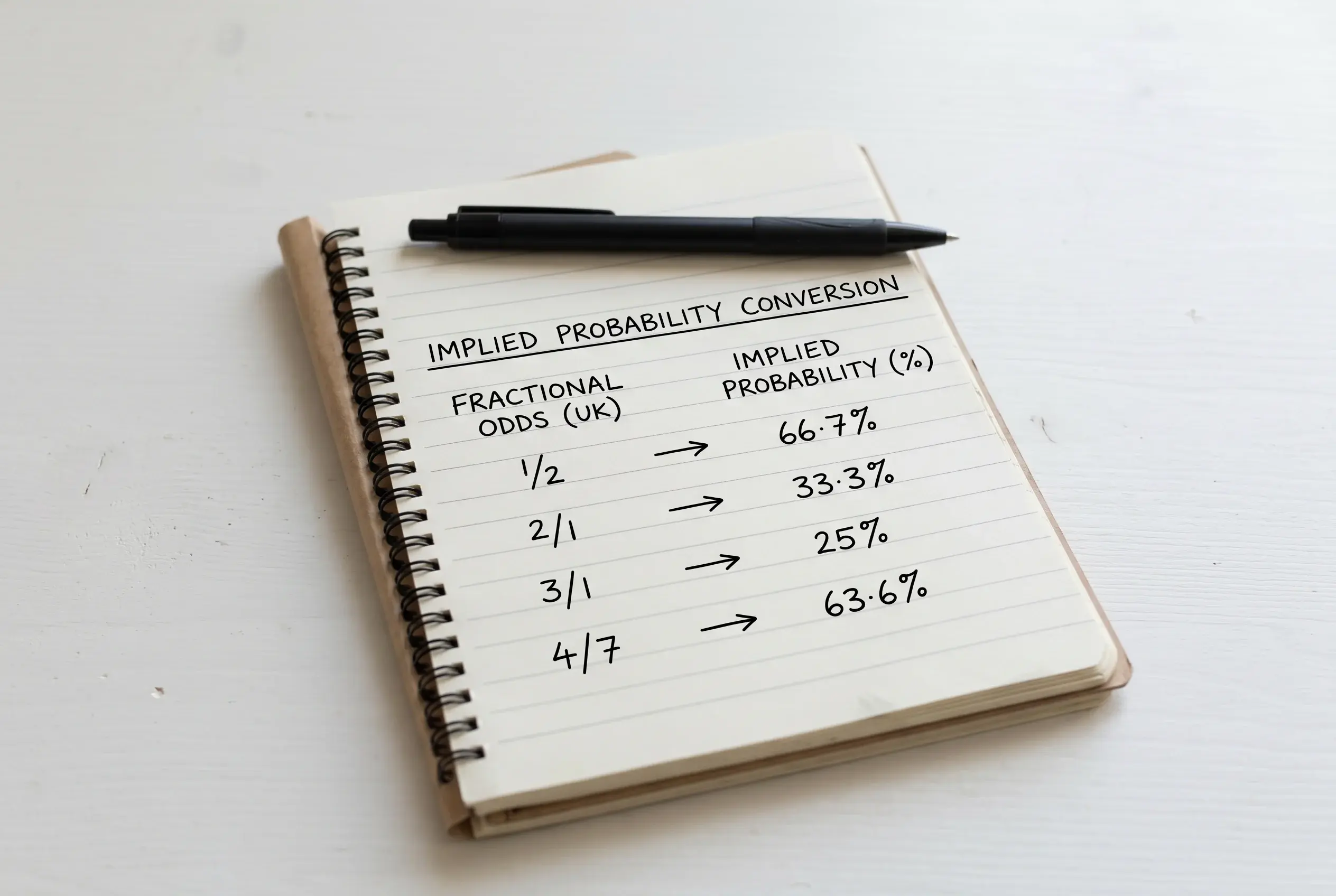
The approach that works is to start with the dominant leg. If your three-leg builder is “Fighter A wins, fight goes the distance, over 2.5 rounds”, the dominant leg is “Fighter A wins” – it’s the most uncertain, has the broadest range of plausible probabilities, and drives the overall outcome. Estimate that probability first. Then conditional on that leg occurring, estimate the probability of the other legs occurring together. If Fighter A is a 60% favourite and has historically gone the distance in 70% of her wins, and her opponents have historically pushed her fights past 2.5 rounds in 75% of those distance wins, the rough joint probability is 60% × 70% × 75% = 31.5%. Implied probability at that level corresponds to about 19/9 decimal odds – call it roughly 11/5 in fractional terms.
If the bet builder is offering 7/2 on that combination, the implied probability is 22.2% – meaningfully below your 31.5% estimate. The bet is value-positive. If the same builder is offering 2/1, implied probability is 33.3% – at or slightly above your estimate, and probably not worth the bet.
The conditional probabilities are the hard part. Anyone can multiply Moneyline odds. The skill in bet builder pricing is in knowing which leg conditions the others and adjusting the joint estimate accordingly. UFC favourites win 68.12% of fights historically – but the rate at which their wins also go the distance varies enormously by weight class and fighter style. A flyweight favourite is not a heavyweight favourite, and the conditional probabilities reflect that.
The stake limits operators apply to bet builders
A bet builder that’s offering value will hit operator stake limits faster than a single-leg bet. The combined-bet flag tags the slip as higher-variance from the operator’s perspective, and risk teams set lower maximum stakes on bet builder slips than they would on the same money distributed across single bets.
The practical numbers vary by operator and by market. A high-volume UK operator might cap a UFC main event Moneyline at £5,000-10,000 for a recreational account but cap the same account’s three-leg bet builder on the same fight at £200-500. The reasoning is straightforward – the operator can hedge a single Moneyline bet against the rest of their book easily, but a specific three-leg combination is harder to hedge, so the maximum exposure they’ll accept is lower.
For most recreational bettors this isn’t an issue. The stake limits are well above typical recreational stake sizes. For sharp bettors looking to load up on bet builders they’ve priced as +EV, the limits are a real constraint. The workaround that some bettors use is splitting the conceptual bet across multiple operators – placing similar bet builder structures at three or four UK books simultaneously to access the cumulative capacity. The downside is that the operators’ correlation models differ, so the “same” bet builder at four books will pay different prices.
When the bet builder is actively worse than a true parlay
Not every bet builder is the cheaper option. Some combinations are priced more tightly when constructed as a true parlay of independent fights – Fighter A to win Fight 1 and Fighter B to win Fight 2 on the same card, for example. The events are independent in the relevant sense, the operator can price each leg through its standard Moneyline model, and a parlay engine handles the multiplication cleanly.
Some UK operators offer this as a separate “same game parlay” versus “multi-fight accumulator” distinction. The bet builder applies to legs from a single fight. The accumulator handles independent legs across the card. The prices for accumulators are usually closer to the pure multiplication of individual leg prices, with a single overround applied at the end. The prices for bet builders are model outputs with the operator’s correlation assumptions baked in.
The rule of thumb that holds across UK books: if your legs come from different fights, build them as a standard accumulator rather than feeding them into the bet builder. The pricing on independent legs is cleaner and the stake limits are typically more generous. The bet builder is the right product when your legs come from a single fight and the correlation between them is genuinely material to the price.
What changed about bet builder marketing under UKGC 2025 rules
UK operators were heavily promoting bet builders through SMS and email push notifications in 2023 and 2024 – pre-built three-leg combinations on the main event of every UFC card, sent to customers in the hours before the prelims. The marketing volume was high enough that bet builder revenue became a material line item in operator quarterly reports.
The May 2025 UKGC consent rules changed that distribution. Operators now need consent per product and per channel before sending direct marketing – meaning a customer who’s opted in to “UFC Moneyline alerts via email” hasn’t necessarily opted in to “bet builder promotions via SMS”. Operators have had to rebuild their consent flows and, in many cases, recapture consent from existing customers for the specific product-channel combinations they want to keep marketing through.
The effect on pricing was minimal – bet builder prices on operator sites are unchanged. The effect on volume was real. Operators reporting bet builder revenue in Q3 2025 quarterly statements noted reduced push-driven volume, partially offset by organic web and app volume from engaged customers. The bet builder hasn’t gone away; it’s just less aggressively shoved at people who weren’t going to use it anyway. For bettors who do use the product, the underlying mechanics are exactly the same as before. To go a layer deeper on managing in-play exposure once a builder is placed, the cash out feature changes the maths considerably.