

Structural Differences in UFC Betting Markets
The first time I sat down to price a UFC card properly — pen, paper, the lot — I tried to use the same mental shortcuts I used for football. Within an hour I had given up. A football match has roughly three outcomes that matter to the average punter and a tail of side markets built on goals, cards and corners. A UFC bout looks simpler on the surface, but it is not. You have two fighters, three or five rounds, and a finish that can come in four flavours plus a draw, plus a No Contest. That is already more legitimate states than most one-off football bets, and every secondary market is just a slice of that same tree.
That is the lens I want you to keep through this guide. There is no such thing as a “UFC prop bet” that exists on its own. Every market — Method of Victory, Round Betting, Total Rounds, Goes the Distance, Performance bonuses, the lot — is a re-shape of the same underlying probability that the moneyline is already trying to capture. Once you see that, you stop chasing markets and start choosing the one that matches the question you actually want to ask. Over a long enough sample, with no operator-specific weirdness, UFC favourites end up winning somewhere around 68 percent of fights, and that 68/32 baseline is the shadow you will see behind every market on this page. The chapters below are a map, not a tipping sheet — what each market grades as, how it is priced relative to the moneyline, and the traps that catch UK bettors who treat MMA like football.
Moneyline — the engine room of every UFC card
I once watched a friend stake his entire Saturday-night bankroll on a Method of Victory pick without checking the moneyline first. The fighter he wanted by KO was a +180 underdog on the moneyline; the KO win was priced around +650. He thought he was getting better value because the number was bigger. He was not. He was buying the same opinion three times over with more friction.
The moneyline — or “Match Winner” on most UK sportsbook tabs — is the answer to one question: who walks out of the cage with their hand raised, regardless of how the fight ends. KO, TKO, submission, unanimous decision, split decision, technical decision — all settle the same way. The only outcomes that void or push the bet are a draw, a No Contest, or a fight that does not start. Every other UFC market in this guide is derived from this single price.
That derivation matters because it tells you something about value. If a fighter is -150 on the moneyline, the market is saying their probability of winning sits around 60 percent before margin. Any downstream market — Method, Round, Distance — has to fit inside that 60 percent. Backing the same fighter to win by KO in Round 1 is not a different bet from backing them on the moneyline; it is the moneyline with an extra constraint, and that constraint is what you are paying for in odds.
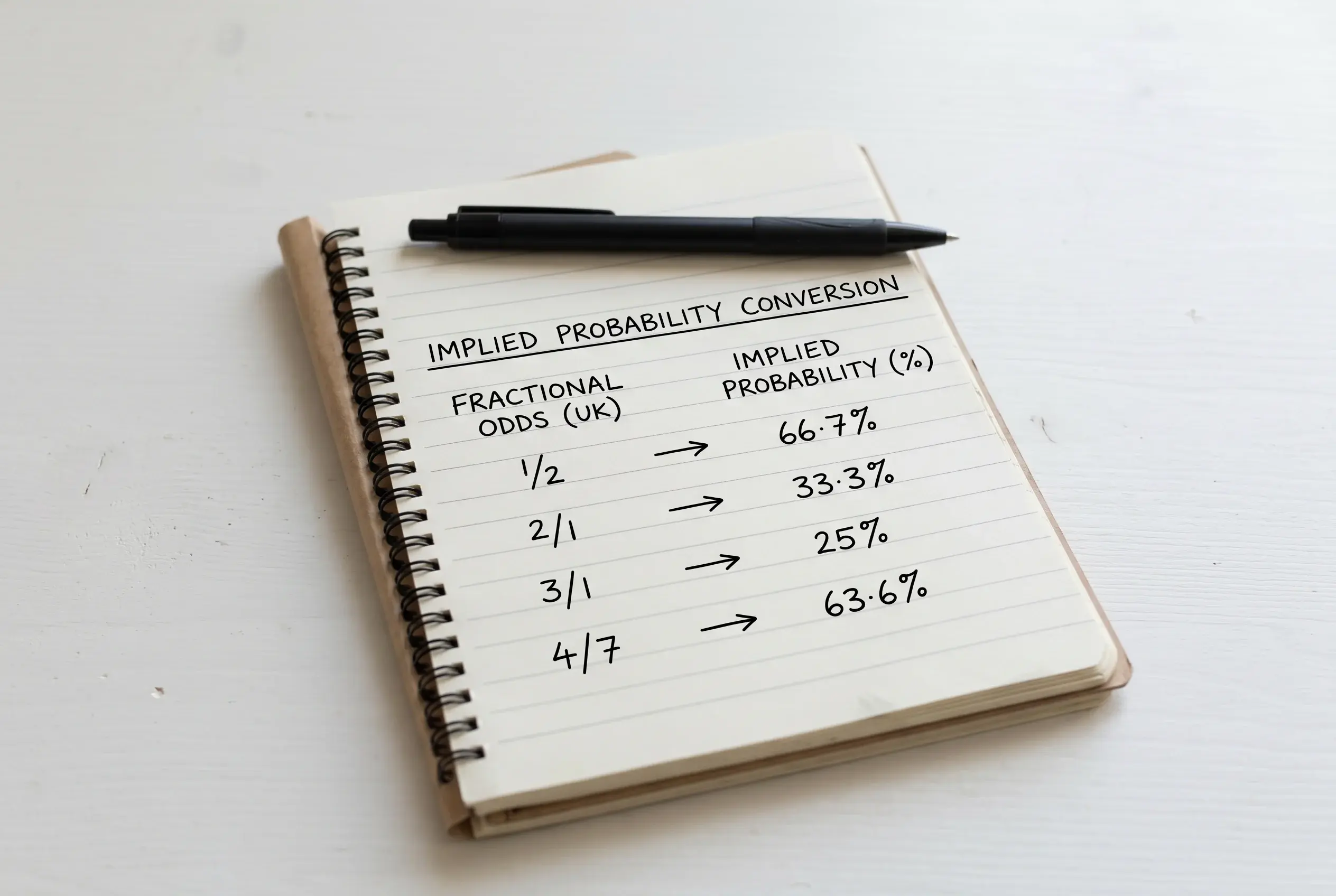
UK books display moneyline odds in fractional format by default. A favourite at 4/6 returns £6 profit on a £9 stake. An underdog at 11/4 returns £11 profit on £4. Fractional odds hide implied probability less politely than decimal — 4/6 is roughly 60 percent, 1/4 is 80 percent, 11/4 is around 27 percent. Many UK operators tag the same market as “Fight Winner” or “To Win Bout” rather than Moneyline; the grading is identical, the label is a hangover from US sportsbook lexicon mixing with British conventions.
Now the favourite-baseline question. Across the long history of UFC, favourites cash about 68 percent of the time, and in the more recent 2024 sample that figure tightened to 72 percent. That sounds like a green light to back chalk blindly, and it is exactly the trap that strips bankrolls. Win rate is not return. Backing only favourites at average prices does not break even, because the implied probability of those favourites is usually higher than 72 percent once margin is added. The moneyline is the engine; the trick is knowing when to ride it and when to switch to a downstream market that asks a more specific question.
Method of Victory — choosing the shape of the finish
Here is a confession. For my first two years analysing UFC properly, I treated Method of Victory like a roulette wheel — four pockets, pick the most likely, hope for the best. Then I started tracking my own grades and noticed something embarrassing. My Method picks were no more accurate than my moneyline picks; I was just paying a bigger margin to express the same opinion.
A standard UFC Method of Victory market gives you four options for each fighter: KO/TKO, Submission, Decision, and on some books “Technical Decision” or “Disqualification” folded into a residual bucket. That gives eight named outcomes plus a Draw line, and the prices have to sum, with margin, to the bookmaker’s view of the entire fight tree. The thing that catches new bettors out is the silent assumption built into the price. A KO/TKO win for a striker priced at +280 is not just “this fighter wins by KO” — it is “this fighter wins” multiplied by “the win comes by KO”. If you already think the moneyline is wrong on the fighter, Method amplifies the disagreement. If you only have a view on how the fight will end conditional on the winner you already trust, Method is the cleaner expression.
Pricing logic varies by archetype. A grappler with a 60 percent finish rate by submission and a thin striking record will see their KO line drift to triple-digit underdog prices even when they are the moneyline favourite. A heavy hitter in a division where favourites cash at the rough 72 percent rate seen across 2024 will see their KO line priced shorter than the decision line, sometimes uncomfortably short. UK books are not blind to fighter styles.
Two grading rules trip people up. First, a doctor stoppage between rounds grades as a TKO for Method of Victory purposes on every major UK book I have used. Second, a technical decision — fight stopped before five rounds due to an accidental foul and goes to the cards — usually grades as a Decision win, but the wording in operator T&Cs varies. Before you stake on Method, open the operator’s Sports Rules page and search “MMA” or “UFC” specifically. It will save you the post-fight chat-support war I have lived through more than once.
The most underused variant on UK sites is “Method of Victory — Double Chance” or “Method Group”. This combines KO/TKO and Submission into “Fighter A by Stoppage” or pairs Decision and Submission into “Not by KO”. The price is shorter than the individual Method line but longer than the moneyline, and for a grappler who wins almost everything by submission or decision but rarely by knockout, the “Not by KO” group is a genuine middle ground between safe and expressive.
Round Betting — pinning the exact moment of the finish
Round Betting is the market I most often get asked about by friends who want to “win big on UFC”. My answer is always the same — yes, you can win big on it, and yes, you will lose a lot to learn that. This is the highest-variance market on a UK book’s UFC menu, and the price tag reflects it.
The market asks you to predict the exact round in which a specified fighter wins, or the fight ends. A standard three-round non-title fight gives you six “Fighter A wins in Round X” lines, plus a “Goes the Distance / Decision” line, plus a draw bucket. A five-round main event doubles the leg count for early stoppages. The book asks you to commit to both the winner and the timing window, and the prices stretch accordingly. I have backed Round 1 finishes in lighter weight classes at 9/1 and watched them cash; I have also stared at the 9/1 ticket as a fight crawled to a Round 3 decision.
Round 1 finish lines are where the pricing is most interesting to me. There is a fighter in the heavyweight ranks whose average fight time across his career sits around two minutes and eighteen seconds — Tom Aspinall holds that record. When he is the moneyline favourite, his Round 1 finish line is priced shorter than almost any other UFC fighter on the card. That is the book paying tribute to a real statistical reality, not laziness. If you back Aspinall to win in Round 1 you are not buying a long shot, you are buying the most likely outcome of the fight at a price that reflects how often it actually happens.
Mid-fight rounds are the awkward middle of the market. The probability of any specific middle round ending the fight is lower than Round 1 (which collects the explosive early finishes) and lower than the final round (where the trailing fighter gambles for a comeback). The prices look generous; the implied probability is low and the variance brutal. I fade middle-round bets unless I have a very specific read — a fighter known for late-round game plan switches, or a clear cardio gap.
Championship fights add a structural wrinkle. The final round in a five-round fight is genuinely a different beast — fighters know they have to make something happen, and Round 5 finishes show up more often than Round 4 finishes. UK books price this. If you see Round 4 priced shorter than Round 5 on a title fight, that is a market quirk worth checking against the live UFC stats.
One pitfall I have lived. Round Betting voids on a No Contest, the same as the moneyline. But the No Contest rate in UFC is meaningful — the recent eye-poke ruling between Tom Aspinall and Ciryl Gane at UFC 321 is a fresh example — and on a high-variance market like this, a single No Contest can absorb a week of profit. Some books offer “Round Betting — including draw and No Contest” sub-options. They look like edge cases. They are not. And if a fight ends between rounds, most UK books grade it as a finish in the round that just ended; a handful grade it to the start of the next round. Read the rules.
Total Rounds Over/Under — trading length, not outcome
If you have ever watched a sluggish kickboxing-styled bout and shouted at the screen because “they will not engage”, you have already understood the appeal of Total Rounds. This market lets you bet on how long the fight lasts without picking a winner.
The standard formulation is “Total Rounds Over/Under 1.5”, “2.5” for a three-rounder, and lines up to “4.5” for five-round main events. A half-round line resolves at the halfway point of the named round — Over 2.5 in a three-rounder needs the fight to continue past the 2:30 mark of Round 3 on most UK books. Some operators use a different threshold (2:30 of the final round in any fight). Always check.
What I like about Total Rounds is the chance to express a directional view on length without committing to a winner. Two grapplers with poor finishing rates? Lean Over. A heavy striker against a defensively brittle opponent who collapses under volume? Lean Under. Length is often easier to forecast than the binary winner question when both fighters look evenly matched on tape.
Title fights are the obvious shift. A five-round title fight has roughly 67 percent more clock than a three-rounder, and the Over lines move accordingly. But here is the trap. Books often price five-round Total Rounds Overs more conservatively than the maths would suggest, because championship fights skew toward decisions — elite fighters at the top of weight classes finish each other less often than midcard battles. If you bet five-round Overs aggressively expecting the same finish rates as a Fight Night undercard, you will get clipped.
The two structural pushes for Under lines I track: heavy hitters in the heaviest divisions, and short-notice replacements. In the flyweight division, where favourites have posted a remarkable 30-8-1 record across recent years and dominate at a 77 percent rate, the Over lines often look long because the dominance reads more like point-fighting than finishing — flyweight favourites tend to win by decision more often than they finish. Pushes for Over lines: thick-skulled veterans whose recent CV is full of decisions, and stylistic mismatches where one fighter is forced to wrestle for fifteen minutes.
Goes the Distance — the binary cousin of Total Rounds
I sometimes describe Goes the Distance to friends as “Total Rounds with the maths removed”. You are not deciding whether the fight passes the 2:30 mark of Round 3. You are deciding whether the judges read out a decision at all.
The market has two sides: Yes (the fight ends by judges’ decision after all scheduled rounds are completed) and No (the fight ends by stoppage of any kind — KO, TKO, submission, doctor stoppage, disqualification — before time expires). No grey area for half-rounds, no edge cases about which round the corner threw the towel.
I prefer Distance to Total Rounds when I have a clear binary view but no opinion on how long the fight runs before a finish. If I think two strikers will swing all night and someone will fall, Distance — No is cleaner than Under 2.5. If I think a wrestler will smother for fifteen minutes, Distance — Yes is cleaner than Over 2.5 because I do not have to argue with myself about exact thresholds.
Pricing tells a story. When Distance — Yes is priced shorter than Distance — No, the book is saying “this fight will probably go to the judges”. That happens when both fighters have low finishing rates, when neither has a recent KO loss, and when the division historically produces decisions at a high rate. Pure-style flyweight matchups often arrive at the cage with Distance — Yes priced as short as 4/7.
The most common pitfall: a TKO at 4:59 of the final round settles Distance — No. The fight did not reach the final bell. I have seen this catch out punters who watched the entire fight, saw the judges’ scores not get read, and assumed the bet was a push. It is not. A small number of UK books grade a technical decision as Distance — Yes; the majority do not. Read the rules.
Prop bets and specials — the wide jungle
The prop bet jungle is where casual punters get themselves into trouble fastest and where, occasionally, you find genuine value because the book has not priced something carefully. A “prop” is any market that asks a question outside the main outcome tree. Will there be a knockdown? How many significant strikes will Fighter A land? Will the fight end in the first half of Round 1?
I split props into two groups when I plan a card: structural and ornamental. Structural props are tied to repeatable, statistical fight features — strike counts, takedown attempts, knockdown markets. Ornamental props are show-business markets — fighter walks out shirtless, fighter wears red gloves, fighter celebrates by climbing the cage. Books price ornamental props on instinct because the data is non-existent, and that is where you occasionally find a price that looks ridiculous.
Performance bonus props are a UK favourite. Performance of the Night and Fight of the Night are real cash awards given out by UFC after each event, usually one or two of each per card. The market asks whether a named fighter wins one of those bonuses. Pricing is roughly anchored to the moneyline plus a finish-rate adjustment. I have a soft spot for backing aggressive prelim fighters at long prices on this market when they are bracketed against a defensive opponent; the bonus committee rewards activity.
Card-wide specials bundle multiple bouts into one market. Underdog markets here are surprisingly playable because across 2023 and 2024 UFC underdogs still cashed around 32 percent of the time, and card-wide specials assume independence between bouts that is largely accurate. A six-fight card with a 32 percent underdog rate per fight has, in pure probability, roughly a 90 percent chance of producing at least one underdog winner.
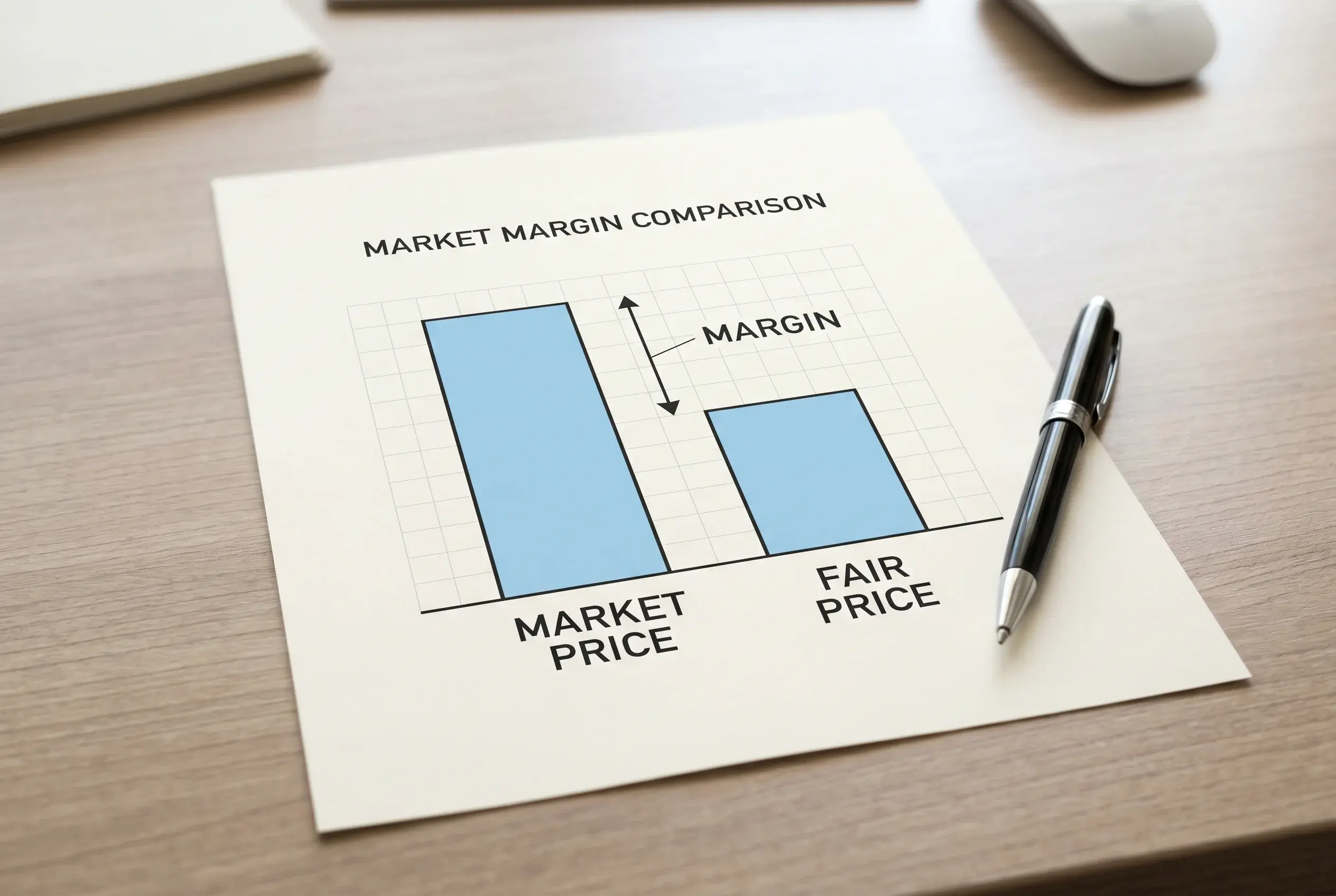
Margin matters here. Prop markets carry the widest bookmaker margin of any UFC market on a UK book. Where moneyline overrounds on a main event often sit around 4 to 6 percent, props can run to 12 percent or more. That is not malicious — props have less liquidity and higher tail risk for the operator — but it is reality. Every time you place a prop, you are paying a fatter toll than on the moneyline. Make sure your edge is fatter than the margin.
For a deeper look at how same-fight builders combine props with main markets, see my guide to UFC bet builders.
Outright and futures — betting on the year, not the night
Outright markets are the slow-burn UFC bets, and they suit a very specific kind of patience. You are not betting on a single fight on Saturday night. You are betting on who will hold the heavyweight title at the end of 2026, or which fighter will win the next interim middleweight championship.
The mechanics are simple. The book lists all plausible candidates and prices each one. You back one, you wait. Your bet is alive until the market resolves — sometimes a single fight away, sometimes a full calendar year. Most UK books will offer settled-when-decided outrights and clearly mark which dead heat rules apply.
What I like about outrights is that they punish lazy moneyline-only thinking. A heavyweight title outright is not just “who is the best heavyweight” — it is “who will be the heavyweight champion at a named future date”, which collapses into a chain of conditional bouts. The reigning champion has to survive his next defence, his next contender, and the man waiting after that. Each step has its own probability, and the outright price has to multiply them. As Tom Aspinall put it after finally securing the undisputed title — he had always cared about the heavyweight title and being recognised as the best heavyweight on the planet. That kind of single-minded focus is the difference between fighters who hold a belt and fighters who hold it for several defences in a row.
The most common edge in outrights is divisional knowledge. If you know a young contender is two wins away from a title shot and his next fight is against a beatable opponent, his outright price will lag the reality by a fight or two. Books update outrights slower than match prices, and that lag is your opportunity. I track three outright markets at any time and re-price them mentally after every relevant fight.
One pitfall — outrights are usually non-refundable if your chosen fighter retires, is cut, or fails a drug test mid-bet. Once your stake is on the table, the book is not interested in your reasons. Read the dead-fighter rules before you stake serious money on a long-shot.
Combining markets — parlays and the multiplier trap
The first parlay I ever placed was a six-leg UFC accumulator built entirely on -300 favourites. I thought I had found the safe road to a big payout. Five legs cashed. The sixth was a flyweight upset I will not name. Total return on the stake — zero. Total useful lesson — priceless.
A parlay (called an accumulator on most UK sportsbooks) combines multiple bets into one ticket. Every leg must win for the bet to settle. The payout multiplies the decimal odds of each leg, which is why even modest odds compound into eye-catching numbers: a six-leg parlay of even-money picks pays roughly 63/1.
The maths is honest but ruthless. A 60 percent favourite has a 0.6 probability of winning. Six of them in a row has a 0.6 to the sixth power probability — about 4.7 percent. The fair price for that parlay is roughly 20/1, not 63/1, because you are paying margin on every leg. UK books love these tickets because the compounding margin alone — typically 4 to 6 percent per leg on UFC moneylines — turns a “fair” six-leg parlay into a sub-50-percent return on average even when you pick competently.
That does not mean parlays are always bad. There are two cases where they make sense. First, when you have genuine high-confidence singles and a smaller stake than you would commit to one bet — the parlay lets you take a long-shot ticket on a fixed downside. Second, when you have correlated legs that the book has not priced as correlated, which is the trick that bet builders try to capture.
Discipline beats imagination on parlays. Three legs is my mental ceiling for serious money. Beyond that, I am playing for entertainment, not for return.
How market depth differs across UK sportsbooks
One thing the affiliate sites never tell you straight: the headline list of “available markets” on a UK operator’s UFC page is not what you actually get on fight night. Two books can both advertise Method of Victory, Round Betting, Total Rounds, and prop bets — and you will still find the second book’s prop list is three lines deep while the first stretches to fifteen.
Market depth on a UK book scales with two factors: the importance of the fight on the card, and the operator’s own MMA trading team. A heavyweight title main event on a numbered card will have every conceivable market open, often including round-by-round strike volume props and Performance bonus odds. The same operator’s third prelim — a regional debutant against a UFC newcomer — might only have a moneyline and a Method of Victory split. Anything more granular requires a trader to set lines manually, and not every book is willing to pay a trader for low-liquidity prelim fights.
If you bet across multiple UK operators, expect duplicate moneyline coverage on every fight, partial Round Betting coverage on prelims, near-universal Total Rounds and Distance on main-card bouts, and patchy prop markets that change by operator and by week. A market that was deep last Saturday might be one line wide for the next event because the trading team had a tough week. This is the structural reality of UFC betting in the UK.
Pick the operator whose market depth matches your bet style. If you only ever play moneyline and Total Rounds, every UK book covers you. If your edge is in Method of Victory or prop markets, line-shop more carefully — that is where the 4 to 6 percent moneyline overround stretches to 10 percent or more, and where two books on the same fight can price the same prop with a 50-point gap.
Frequently asked questions about UFC betting markets
The questions below come up most often when I am asked about UFC markets — both from readers and from friends who only bet on big PPV cards. Each answer reflects how UK operators currently grade these markets in 2026 and how I personally treat them when placing real money on the line.